Only rarely do I find the time or inclination to let you know what we have accomplished. One of the curses of a business like this is we never have time to recline and enjoy our handiwork, We are invariably rushing to the next contract, to the next meeting. As my grandmother often said, “there is no rest for the wicked” (which, to this date, I still do not understand). We are proud of all of our projects, and here are a select few that are in the headlines at the moment.
Illinois
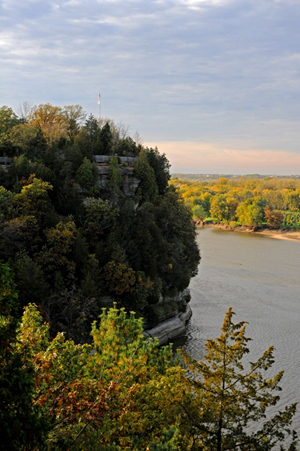
Illinois River Road Scenic Byway
Starved Rock
A few weeks ago I wrote on our weblog about the Illinois River Road Scenic Byway. This byway runs along the Illinois River from (roughly speaking) Starved Rock State Park to the Nature Conservancy’s Emiquon sanctuary and Havana.
Anaise Berry is the Director for the Illinois River Road National Scenic Byway, and this morning she sent me the following:
The Illinois River Road National Scenic Byway’s website had 7,790 visitors during the month of September, a 25% increase over the average number of monthly visitors – a new high for the two-year old website. Although visits to the Byway website have been trending steadily upward, this boost likely resulted from a lengthy feature article about traveling the Illinois River Road, which appears in the October 2010 issue of Midwest Living® Magazine.
The Midwest Living® article has generated considerable interest in the Byway region, stretching from Ottawa to Havana, also resulting in a record number of requests for information about the region. These requests for visitor information are coming not only from Chicago area residents, but also from Wisconsin, Indiana, Michigan and Iowa. This kind of attention puts all of our Byway Gateway, Portal and Supporting Communities in the “visitor spotlight,” showcasing this very special region to potential visitors.
With the Calendar of Events being the most frequently visited page on the website, this is a great time for communities, sites and organizations to upload events and goings-on scheduled for this Fall, Winter and next Spring! Byway travelers are looking for authentic experiences along their journey, and will plan their itineraries based upon events and sites in the various Byway communities. Festivals, cultural events and eagle watching are just a sampling of the events are visitors want to explore.
Hackmatack
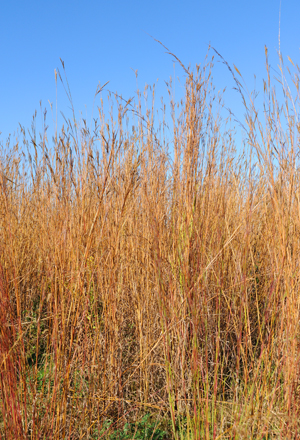
Big Bluestem
The U.S. Fish and Wildlife Service has announced their decision to proceed with a study to determine the feasibility of establishing a Hackmatack National Wildlife Refuge in the bi-state region of southeastern Wisconsin and northeastern Illinois. Long known as an ecological hotspot, the region is home to many rare bird, fish, freshwater mussel and plant species, as well as some of the world’s most globally imperiled natural communities, including tall grass prairie and oak savanna. Fermata, under contract to Openlands and the Trust for Public Land, developed a viability study for this proposed refuge. This effort has received unflagging support from the Friends of Hackmatack, and nowhere did their support count more than in the four public meetings held by the USFWS to discuss the refuge. We are elated to see that USFWS continue on with this important project.
Pennsylvania
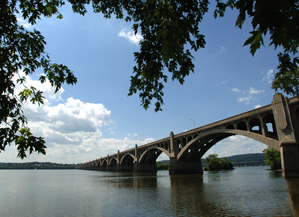
Columbia bridge, Lower SusquehannaFermata finished its final Conservation Landscape Initiative (CLI), the Lower Susquehanna. Of the seven PA DCNR CLIs Fermata developed five. This approach to sustainable development, recreation, and tourism has already received recognition. In 2009 the National Association of Recreation Resource Planners (NARRP) recognized PA DCNR with its planning award for the Laurel Highlands CLI, one of Fermata’s projects. The department’s regional approach to conserving landscapes and tying them to economic growth for communities is one of the creative government initiatives chosen for the “Bright Ideas Program” by the Kennedy School of Government at Harvard University. Ted Eubanks and Fermata began working for PA DCNR in Pennsylvania a decade ago, and our earliest work on elk watching in Northcentral PA became the PA Wilds and the CLIs. Congratulations to all.
The weather heads salivated for days. Nothing provokes a Pavlovian response in weather geeks more than another storm of the century (How many are we allowed in one century?). I knew Pittsburgh to be in the path, but we glided into town with little trouble. Deplaning I watched the frontal system sweep the runway, and by the time we entered the terminal spitting rain and raging winds shook the building. Scheduled to speak in West Virginia the following day, I sprinted to my rental car and headed west toward the interstate. I made the mistake of following the directions dictated by my iPhone, and soon I left the interstate far behind and slid toward Appalachia on a narrow, serpentine two-laner.
While certainly no hurricane (I love how the weather heads trot out that analogy.), I decided that the rain, wind, darkness, a narrow road, and 60-year-old eyes did not blend well. I bailed early. Reaching I-76 (my route south), I navigated toward Cambridge, Ohio. I am not sure if I had previously heard of Cambridge, but I am certain that I never visited (To be honest, I still don’t know why I ended up in Ohio.). Situated at the intersection of two interstates, I suspected that I could find a hotel and restaurant along the highway. I exited the freeway at Cambridge and entered the American Everywhere.
James Kunstler characterized America as “ever-busy, ever-building, ever-in-motion, ever-throwing-out the old for the new; we have hardly paused to think about what we are so busy building, and what we have thrown away. Meanwhile, the everyday landscape becomes more nightmarish and unmanageable every year. For many, the word development itself has become a dirty word.” Cambridge, I found, is this everyday landscape. The town offered its handshake with Ruby Tuesday, Hampton Inn, McDonalds, and Pizza Hut. All were the same as at home; all were the same as found throughout interstate America. To Kunstler this is nowhere; to me it’s everywhere.
America is new, rootless. Americans share an impoverished sense of place. We have no Mecca, no Angkor Wat, and no Taj Mahal. American natives have special places, but we immigrants see little value in them. Consider the conflict over Bear Butte, South Dakota. To the Lakota this is sacred ground. To Sturgis this is a potential campground and parking spot for Harley riders.
Early conservationists believed that America’s specialness could be found in her landscapes. Theodore Roosevelt said that “There can be nothing in the world more beautiful than the Yosemite, the groves of the giant sequoias and redwoods, the Canyon of the Colorado, the Canyon of the Yellowstone, the Three Tetons; and our people should see to it that they are preserved for their children and their children’s children forever, with their majestic beauty all unmarred.”. For Roosevelt, what America lacked in ancient monuments and edifices it more than gained with her transcendent lands and wildlife.
Americans, however, are now becoming detached from this heritage, with these special places. Roosevelt warned that “the lack of power to take joy in outdoor nature is as real a misfortune as the lack of power to take joy in books.” How many Americans take joy in either? In 2004, a National Endowment for the Arts report titled “Reading at Risk” found only 57 percent of American adults had read a book in 2002. The Outdoor Foundation reports that over half of Americans “take no joy in outdoor nature,” with alarming numbers of children divorced from the outdoors.
Now, slipping into Cambridge, I confront the America devised by its marketeers. I see the America invented by global hucksters, their goods relentlessly hawked on the ubiquitous television. The McDonalds on the screen is the McDonalds in Cambridge. The Wal-Mart on television is the Wal-Mart in Cambridge. The streets signs, billboards, traffic lights, and facades are no more real in Cambridge than on the tube. This version of America, known by all, is fakery unleashed and unlimited. I can’t decide if I am in the Matrix or the Truman Show.
As a child I would visit my grandparents in Paris (Texas) several times a year. In that pre-interstate age (President Eisenhower, who initiated the interstate system, did not begin his presidency until 1953.), the roads invariably wended from downtown to downtown. My sister and I knew every hamburger joint and rest stop between Bryan and Paris. Even today I remember the sweet-and-sour lusciousness of the limeade in Sulphur Springs. Each town along our route had an identity, a character.
Now, your McDonalds is my McDonalds, your Wal-Mart is my Wal-Mart. Why leave home if all that is offered away is the same as in your neighborhood? Forget the family that once owned and worked in that Sulphur Springs hamburger and limeade joint, or the snow cone cart by the railroad track that my grandfather would take us by after work. What is more important to Everywhere America is that (1) everywhere is the same, and (2) everywhere is cheap.
One hotel is easily replaced by another (Hampton by Holiday Inn Express). One restaurant is easily substituted for another (Ruby Tuesday by Chiles). But what about that for which there are no substitutes? Would you replace Gettysburg with any Civil War site? What about substituting a pileated for the ivory-billed woodpecker, or a mourning dove for the passenger pigeon, or a penguin for the great auk? In a world of cheap throwaways and easy replacements, that which cannot be replaced is at risk.
Returning to my factory hotel I jotted a note on Facebook about Cambridge, a brief snippet asking “where the hell am I?” The responses came immediately. One friend wrote “heard of it. Dangerously close to my old stomping grounds and soon to be new stomping grounds. And yes, there’s really not much there!!” My heart sank (not really; I stopped for a meal and a bed). Then another friend sent the following: “You are near an excellent birding location! It’s called “the Wilds.” It’s a reclaimed strip mining area… The facility also has yurts for overnight guests. Very cool place and staff.” Soon another posted that “that area is full of special places…the Wilds being number one.” Humm, there seems to be a there there.
But how would you know if you bumped into Cambridge from the interstate? Like America, Cambridge is hidden by a shiny plastic wrapper. Only when you peel the layers back do you find the meat on the bones, the Hocking Hills, the Salt Fork State Park, and the Wilds. The American marketing machine sells gloss and I am interested in gristle.
How can we save that which does not exist for most Americans? Federal programs such as the National Heritage Areas and America’s Byways are selective and only touch on a few of these special places. Getting people into the outdoors is only a small part of the challenge. First, they need to know where to find the outdoors. Second, once there they need help in connecting to the land, its recreations, and its stories. Modern television marketing is delivered turn-key, without any requirement that you think. In the outdoors, the experiences are earned rather than gratis.
Finally, our special places need space. The American soul (as tangibly embodied in these places) is being squeezed from all sides, with what makes the American experience special being pushed aside for a marketeer’s version of the American story. American places need space in the American mind and in the American landscape. These are the American touchstones, special places with names and physical locations where we return to remind us of who we are, what we have accomplished, and how to navigate forward based on our past experiences.
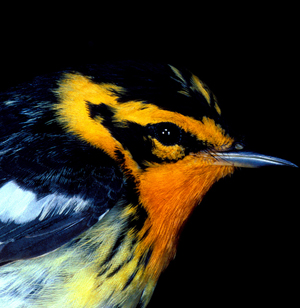
Blackburnian Warbler
Isn’t this a critical aspect and appeal of birding? Each spring I return to the Texas coast to see the same birds that pass through the same special places such as High Island. With each day new migrants appear, northern parula followed by rose-breasted grosbeak followed by blackburnian warbler followed by yellow-billed cuckoo followed by least flycatcher. What could be more reassuring than the annual reappearance of birds that we exert absolutely no control over? As long as we protect their places, their cycle will continue. As long as we protect their places, our children and grandchildren will find the same inspiration and joy in this spring ritual that I have for the past four decades.
In the early 1990s I begin developing the first birding trail with Texas Parks and Wildlife. I remember being criticized by a group from Colorado that assured me that “real” birders did not need my birding trails. Perhaps “real” birders can find these special places, but the vast majority of the rest of us can’t. With initiatives such as birding trails, IBAs, and eBird places we are bringing America’s special birding places to the attention of the public and the officials guided by their sentiments. Birding trails are a celebration of birding places, those parks, refuges, and sanctuaries where we return to reassure ourselves that the world is still spinning and that the birds are still migrating.
America is adrift, stumbling forward with a road map drawn by shock-jocks and gas bags. When lost we tune in our favorite bloviator and ask for directions. Yet there is a real behind the unreal, a wonderful store filled with goodies behind the facade. If you want to know the American story, you must experience the American places. If these places are to continue to comfort, inform, enlighten, entertain, inspire, enliven, guide, and reassure us, then they must be given ample space in the American psyche. America, now more than ever, needs space for place.
Common PauraqueStephen Hawking hurts my head. I am certain that he is the best-selling, least-read author in any of his infinite number of possible universes. I wonder how many have started A Brief History of Time only to bail by the second chapter. Has anyone actually finished one of his books? I do not doubt that he has helped popularize cosmology; I am not sure with whom.
Alternative universes, however, I grasp. I hear one every night as I stare at the 3 a.m. ceiling. Crickets and cicadas underpin the more penetrating tones. A screech owl’s tremolo vibrates through my bedroom, catapulting two cats into an open window. A raccoon cracks his way through this fall’s pecan crop. Nighthawks speent, horned owls boo, and plovers recite onomatopoeias across the night sky. In late fall these familiar sounds will be joined by migrants, each marking its presence in my airspace as they drift south.
Night has always mystified us. The dark space outside the campfire’s glow is the other world, a void filled with every conceivable monster, ghost, troll, and ghoul. Now I learn from Hawking that this is simply one of an infinite number of possible universes, along with mine filled with house cats, raccoons, and owls.
To ancient man these night sounds confirmed ancient fears. Could a ghost be any more terrifying than a cadaverous barn owl hovering around a church steeple hissing its goose-pimpling shriek? Consider the names given night callers such as chuck-wills-widow, whip-poor-will, and poor-will. What did Will do to deserve this fate? Known as nightjars (their calls jar the night), the Caprimulgids include the nightjars, goatsuckers, frogmouths, potoos, and the oilbird. Birds of the day become alluring tits, warblers, and kingbirds. Birds of the night suck goats.
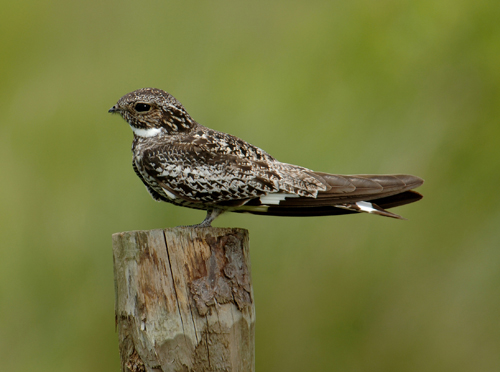
Common Nighthawk
While we may not be awake to see them, the list of nocturnal animals is impressive. Owls, nightjars, rails, and night-herons are among the birds. In Galveston I have seen migrants such as Empidonax gleaning bugs from my well-lit window screens late into the night. Most land birds migrate at night, and an entire science has arisen to detect these movements through Doppler radar and night calls. Many seabirds leave their nests only at night to avoid predators. Night may be an alternative universe, but at least it is well occupied.
To birds add coyotes (until Hurricane Ike flooded our island, coyotes were frequently seen loping through the main tourist district downtown), foxes, armadillos, amphibians (the gulf coast toads that mate in my backyard pond drown out all other organic night sounds during their summer peak), and snakes. Life on this planet is 24/7, with no days off. Life is an inexorable, relentless force, sifting into every crevasse, every niche of this planet.
Most of what I hear, though, is the sound of oil. Mopeds, garbage trucks, police patrols, Boeing 737s, unmufflered street cars, churning locomotives, spewing oil refineries, petrochemical barges, and cruise ships pollute my sound scape, and shove native life and sounds into the background. I try to imagine life before Drake, before Oilcan Harry. I have read that the Greeks would not have developed their constellation-based mythology if faced with the light pollution of today’s Athens. More than one fifth of the world’s population, two thirds of the U.S. population, and one half of the European Union population have already lost naked eye visibility of the Milky Way.
What about sound pollution? Nightjars often have onomatopoetic names, but what if our forefathers had never heard them above an industrial din? Why are light and sound pollution secondary to that of water and air? Isn’t the quality of one’s life impacted by the ability to see and hear, not just being able to breathe and drink? Noise is pollution. Artificial light is pollution. We accept both by scarring them over, accepting deprivation as a cost of “modern” life. How difficult is darkness? How hard is silence?
Ten people who speak make more noise than ten thousand who are silent… Napoleon Bonaparte
Fulvous Owl, El Triunfo, MexicoThe night may be familiar where you live but the exoticism of night is enhanced elsewhere. In 1980 I joined two friends, Fred Collins and Jim Morgan, in a birding trip from Houston to northern Mexico. Fred drove his International Harvester Scout, and I rode shotgun to keep my hands on a four-wheel drive shift that kept jumping out of gear. After a brief stop at El Salto we continued to Mante, arriving in late afternoon. After enchiladas suizas and a couple of Dos Equis, we wandered off in search of los pajaros de la noche, the birds of the night.
Fred knew of a river nearby, and we decided to drive the road that paralleled the riverbank in hopes of seeing one of the Mexican owls. Fred had brought his 1 million candlepower spotlight that plugged into the cigarette lighter, and we puttered our way along the river while punctuating the night with intermittent bursts of blinding light. Close Encounters of a Third Kind had been released just a few years earlier, and I was certain that any spotlighted owl would be blazened in place like Richard Dreyfuss at the railroad crossing.
Our trip halted, sans owls, where the road ended at a small dam. We decided to give the light one last try, and noticed a common pauraque squatting on the road’s warm pavement. Pauraques are common in South Texas, though, and we were in search of exotica. Again Fred lit the trees, and within moments a rifle barrel thrust through his open window. We froze, so blinded by the spotlight that we could not see outside the Scout. Fred doused the beacon, and as our eyes adjusted we saw a young federale fingering the gun. Every governmental facility is guarded in Mexico, and we had unknowingly (or stupidly) wandered into a protected site (did I mention that I also carried a Bushell Spacemaster spotting scope mounted on a gunstock, and while Fred spotlighted I had been looking through optics that to this young man surely looked like a missile launcher or bazooka?).
Joined by a couple of his fellow guards, he asked what we were doing. In my broken Spanish I said that we were looking for pajaros de la noche. He asked me again, and I repeated the refrain. Without warning he and his compadres exploded in laughter, with rifles, spit, and gut-busting guffaws flying loose in every direction. We had no clue what I had said or done to set them off, but we smartly decided that laughter beat bullets. Ted Eubanks, Fred Collins, and Jim Morgan, El Salto, Mexico, February 1980
Eventually the federales regrouped, and I tried to rephrase my earlier answer. I thumbed through my Mexican field guide, and showed the youngest of the group an illustration of an owl, el buho. The group erupted again, this time combined with looks of incredulity. Eventually he blurted out the word “whore,” and we began to get the drift.
Pajaros de la noche had an alternative meaning there – prostitute. The federales had discovered three wide-eyed gringos with binoculars and a spotlight looking for prostitutes along the river. We had stumbled into one of the alternative universes, one in which tourists search for nighttime entertainment with spotlights and a field guide. We all shook hands and enjoyed a good laugh. Fred then aimed the Scout toward the hotel, drove us back through the worm hole, and into warm beds.
The doves are power cooing the windows out of their frames. How did doves and lost love become synonymous? The only sadness I feel is for lost sleep. The main chorus consists of white-winged and Eurasian collared-doves. Both are immigrants. White-wings were limited in my childhood to a few scattered through oaks around the court house. Collared doves were unknown. Now both blanket the city, and I often see droves lined shoulder-to-shoulder, wingtip-to-wingtip, along the telephone wires. This morning the crowds have apparently chosen my yard for their caroling. Cucurrucucú, paloma, ya no le llores.
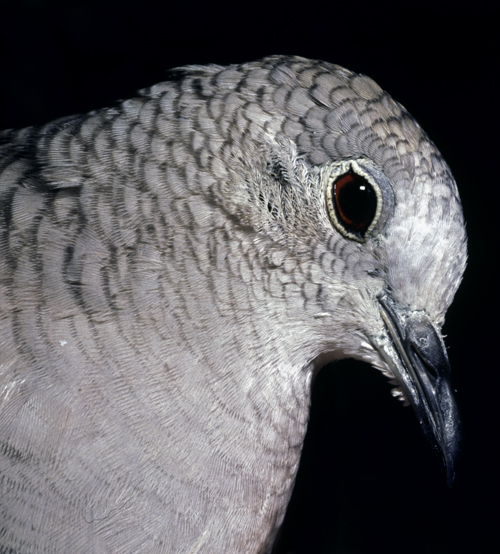
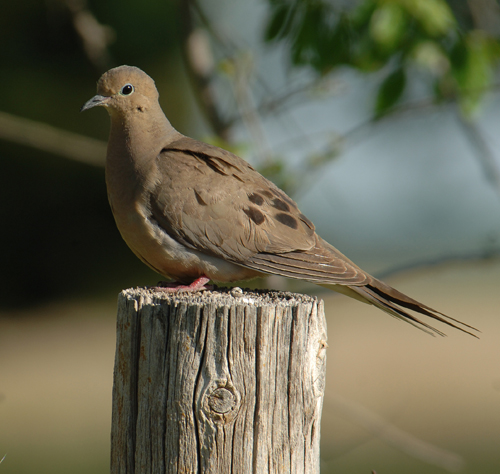
Within this cooing cacophony I detect the slight, almost apologetically soft flutes of the Inca dove. The Inca is also an immigrant, arriving on the island in the 1950s. The Inca survives around the edges, avoiding being bounced by the brutes. I rarely see more than a few together, quietly sifting for seeds through the scalped grass at the Ursuline Convent. The only loser to the recent immigrants is the native mourning dove. Mourning doves have been forced from many Texas urban centers out to the hinterlands.
These changes have taken place over the brevity of one lifetime – mine. I wonder how many people noticed. Perhaps the incessant noise of urban life, the auditory trash, inures us to the coming and going of nature. Our senses are cauterized, and that which we should miss never exists in the first place. Who can hear the pleadings of an amorous dove through ear buds?
Recently I drove to Rockport for a lunch meeting, and once finished curved north along the Texas Coastal Bend before returning home. Time spent along the Texas coast will leave you with two distinct impressions. First, the Texas coast is chock-a-block with birds, particularly doves. Nowhere can they be escaped. Second, also inescapable is the debris and detritus of humanity. Only in protected areas (refuges, private ranches, sanctuaries) and in a few caring towns can you avoid the abandoned double wides, scoured industrial sites, belching refineries and factories, and the tattered, sclerotic communities that define the coast. Yes, we share some of our trashiness with others around the Gulf of Mexico. The truth is inescapable – we are awash in visual and auditory trash. Humans and garbage walk hand in hand along this beach.
I confess; I am an Aldo Leopold aficionado. In college I found his writing tiring, even depressing. Now, at age 60, I hang on his every word. Here is Aldo’s take on the human existence:
One of the penalties of an ecological education is that one lives alone in a world of wounds. Much of the damage inflicted on land is quite invisible to laymen. An ecologist must either harden his shell and make believe that the consequences of science are none of his business, or he must be the doctor who sees the marks of death in a community that believes itself well and does not want to be told otherwise.
Mourning DoveAs birders, as nature watchers, we are, at least at a rudimentary level, ecologists. Perhaps our ecological interests are bottle necked (identifying birds), but I cannot imagine a sentient birder who cannot see both bush and bird. Our experiences with birds and nature should offer us a unique perspective to share with our fellow citizens currently walled off from nature.
Few of us care enough to make the effort. Birding is a game, a pastime through which we relax and escape. We are fortunate, for numbers of birds readily adapt to highly altered landscapes and our disinterest. We look for crows at dumps (aka landfills), waterfowl in settling ponds, pelagics from rip-rap jetties, and shorebirds on tidal flats created by these jetties. Most of us bird in damaged landscapes; few us of have ready access to “wilderness.”
But a park and a trash heap are different. A park is modified, but in a way that most of us find pleasing. Trash is an affront to the senses, yet people, like birds, seem to adapt to a degraded circumstance. Why?
I know the standard arguments – ignorance and poverty. But I have traveled to places where the poor did not live in squalor, where people took pride in the very little that they had scraped together in this life. Along the Texas coast, between these spellbinding protected lands, I see little pride. What I see are heaps of trash.
My family fled to Texas from hard-scrabble Mississippi immediately following the Civil War. I love my state as much as anyone, and from that attachment comes my anger and disgust. Perhaps we in conservation have spent so much time fighting for protected places that we overlooked what surrounds them. Shouldn’t conservation bleed into communities as well?
Nabokov said:
I prefer to accept only one type of power: the power of art over trash, the triumph of magic over the brute.
I hope that no one is born a brute, but I do see many (or evidence of many) who have forsaken art and beauty. Enter birding. Birds, to me, are art more than biology. If we hope to touch the insensate masses, we must use poetry and song as much as prose and science. This is the reason that so many Americans still struggle with global climate change, and, in many cases, are aggressive deniers. With all of our proof, all of our science, we have failed to give the common man the slightest reason to care.
Birds see a world at risk where our crude actions, our trash, spoils even the most rudimentary existence. But birds cannot speak for themselves. We must be their voice to testify. It is not enough to only see, to only watch.
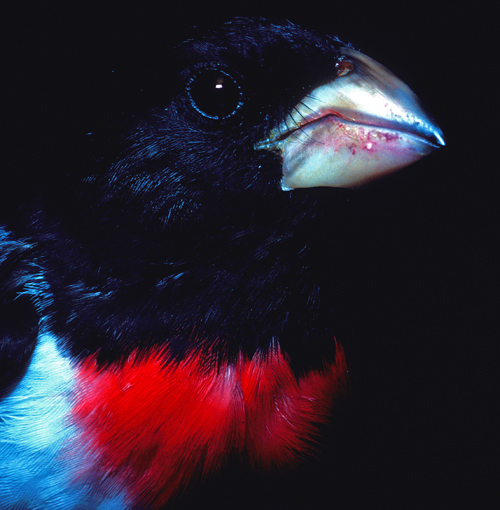
Purple juice spreads over my right shirt sleeve, gradually coalescing into a shape vaguely reminiscent of the Lesser Antilles. I peer upward, through the leaves, and see a rose-breasted grosbeak, its beak and breast equally tinted with a wine hue. The grosbeak gulps fruit with an audible appetite, each mulberry carefully manipulated in that outsized beak into its proper position before being inhaled into the bird’s gullet. Mistakes and choices are made, and a few of the berries slip from its grasp and fall to the ground or onto my shoulder.
Fingering my binoculars, other birds begin to appear within my focus. Buntings, orioles, tanagers, and grosbeaks are packed into this one tree, each enmeshed in a mulberry feeding frenzy. These are the mulberry birds, a cadre of audaciously decorated birds that are lured into my sight by the gravitational pull of one fruit – the mulberry.
In this instance, my mulberry tree is one of a row planted many years ago by Louis Smith in what became Houston Audubon’s Boy Scout Woods Bird Sanctuary in High Island, Texas. One fall Louis harvested a number of substantial branches from mulberries in the area, and then planted sections of the limbs along the pathway into the woods. The following spring these mulberries came to life, with their futures only briefly threatened when a couple of neighborhood kids decided to make their mark by uprooting the fledgling trees. I helped Louis replant the starts, and they seemed to take little notice of being yanked from the ground. I have often wondered how many individual birds have been nourished by Louis’s trees, and how many birders have been stained by their fruit.
The red mulberry (Morus rubra) is native to the eastern United States, spreading along the Texas coast as far south as the Coastal Bend. Birds (particularly migrants) sow the seeds widely through their droppings, and mulberries can be found sprouting in what would seem to be the most inhospitable locations. No matter, though. Come spring the fruit are guaranteed to attract a rich array of mulberry birds, no matter how bizarre the tree’s location might be.
The white mulberry (Morus alba) is a close cousin of the red, brought from Asia to America for silkworm culture in early colonial times. This species has naturalized and hybridized with the native red mulberry. In fact, the white mulberry is considered to be an invasive pest over much of its range. White mulberry is an aggressive pioneer, invading disturbed areas such as abandoned farm fields, highway right-of-ways, and undeveloped urban open spaces.
More ominously, the white mulberry threatens the viability of the red through genetic pollution (undesirable gene flow into wild populations). There are a number of white mulberry cultivars, including those that weep and those without fruit. To be honest, I have as much use for a fruitless mulberry as I do for a heatless jalapeño. The mulberry birds are oblivious to my reservations, and attack the fruits of both with equal zeal.
White mulberry leaves are the favored food for Bombyx mori (silkworm of the mulberry tree), the domesticated silkmoth whose cocoon is the source of silk. Chinese records indicate that the silk moth has been domesticated since 2700 B.C., and the species no longer exists in the wild. The domestic silk moth is now completely dependent on man for its survival and reproduction, and may be the most fundamentally domesticated animal in the world. How ironic that the fruit of the white mulberry is consumed by the wildest of creatures (migrant birds), while the leaves feed the most neutered.
The threat of genetic pollution is hardly limited to mulberries. The native wolf of the Gulf coast, the red wolf, has been on the receiving end of habitat loss and predator control since colonial times, and the remaining few freely interbreed with the expanding coyote. As a result fewer than 300 “pure” red wolves remain in existence.
Golden-winged Warbler
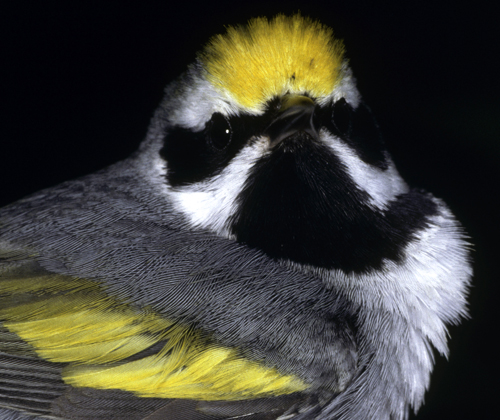
Golden-winged and blue-winged warblers also interbreed, with the hybrids even given their own common names (the dominant Brewster’s, and the recessive Lawrence’s). The golden-winged favors early-succession habitats, such as abandoned farmlands. As disturbed lands reforest, the golden-winged is displaced. In addition, these anthropogenic (man-caused) habitats allow the blue-winged to expand into the golden-winged range. The blue-winged then freely hybridizes with the golden-winged, often replacing the golden-winged within fifty years of its initial arrival. There are concerns that the golden-winged warbler may well disappear as a viable species in the future.
Yet my concerns about man’s tinkering with nature are momentarily shelved as I relish the sight of this grosbeak working his way along the branches like a shopper breezing through the produce section. Each fruit is individually inspected and assessed according to criteria known only to grosbeaks. Is this fruit ripe? Is this fruit sweet? Is this fruit blemished? I also wonder if each individual grosbeak has a particularly taste in mulberries, or does the need for nourishment after a nonstop flight over the Gulf of Mexico trump taste. I can only imagine what drives this grosbeak to choose one mulberry (tree and fruit) over the others, but in the end choices are made. My grosbeak is particular.
My grosbeak is also a short timer, wasting little time with this meal before continuing away from High Island to the forests of the eastern U.S. and Canada. This mulberry tree, here by plan, annually attracts birds that ultimately span thousands of miles of breeding and wintering range. For one moment, one brief instance, this tree is festooned with birds brought together by fruit rather than geography. And, for this same moment, I am brought together with the mulberry birds, also by plan.