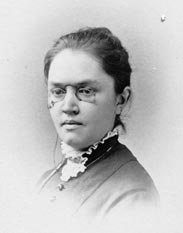
America the Beautiful

Katherine Lee Bates

My youthful reading naturally gravitated to history. In fact, I cannot remember when I didn’t have three of four history books in some stage of completion. Now, armed with a Kindle and an iPad, my consumption has eclipsed what is possible ingesting only words on paper. I am awash in digital history.

My preferences are for world periods that I know little about, and for American conservation history. At the moment I am reading Reston’s Defenders of the Faith. Are you curious about the origins of conflicts between the Christian and Islamic world, between Charles V and Suleyman the Magnificent? Reston is an encyclopedic source. As for American conservation history, I rarely leave the late 19th and early 20th centuries. Roosevelt, Dock, Pinchot, Bird, Rothrock, McFarland, and Lacey inevitably suck me into their vortex.

Recently I have been exploring place as a way that we Americans consider ourselves, in fact, define ourselves. A song that captures that notion for me is America the Beautiful. Consider the first stanza. What could be more evocative of place?

O beautiful for spacious skies,
For amber waves of grain,
For purple mountain majesties
Above the fruited plain!

America! America!
God shed His grace on thee,
And crown thy good with brotherhood
From sea to shining sea!
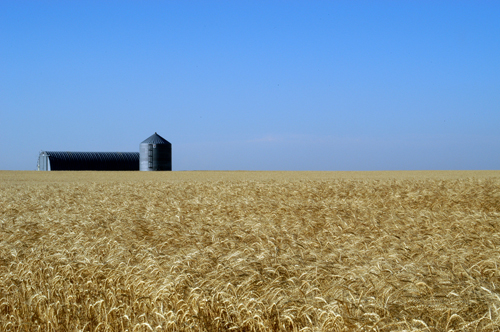
Amber waves of grain, eastern Colorado

I decided to look closer at the origins of this seminal piece of American patriotic composition. Not surprisingly, I found myself back in this frenetic high-period of American progressive politics. At the outset I knew very little about Katherine Lee Bates, the lyricist, professor, social activist, and poet whose words are memorialized in the song. Bates spent her life teaching at Wellesley College, and in addition to her teaching she wrote children’s books, travel books, and poems. Only one of her poems is famous, but, in her case, one is enough. Here are notes that she wrote about her first thoughts about this poem:

One day some of the other teachers and I decided to go on a trip to 14,000-foot Pikes Peak. We hired a prairie wagon. Near the top we had to leave the wagon and go the rest of the way on mules. I was very tired. But when I saw the view, I felt great joy. All the wonder of America seemed displayed there, with the sea-like expanse.
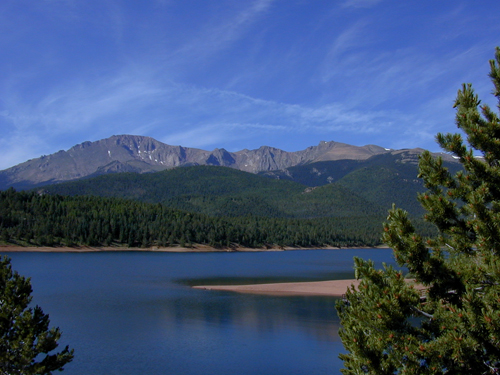
Purple mountains majesty, Pike's Peak

Bates would continue to craft the poem, first published in 1895, for another eighteen years. In 1910 Bates lyrics were combined with the music of Samuel A. Ward as America the Beautiful. The music began life as Ward’s hymn Materna. Ward would never meet Bates, and he died in 1903. Ward never heard America the Beautiful, his music or not. Bates is a different matter.

As I have continued to read about Bates, there are aspects of her life that are surprisingly contemporary. Bates is often described as an ardent feminist (although at that time I suspect suffragette to be more likely.) In addition, although the details of their relationship are sketchy, Katherine Lee Bates spent most of her adult life as the partner of another woman in a “Boston marriage.” While on staff at Wellesley she met Katharine Coman and began a relationship that lasted for 25 years. Most historians have described the relationship as a “romantic friendship,” but there is no doubt that they enjoyed an intensely loving partnership that lasted until Coman died of breast cancer.

Let this soak in for a moment. The author of America the Beautiful, considered by many to be the most stirring anthemic affirmation of our nation, one of the few that most Americans can sing at the drop of a hat, came from the poetry of an educated, progressive, liberated woman who spent her life in a loving relationship with someone of the same sex.

Although I said that most Americans can sing the anthem at the drop of a hat, few make it past the first verse. Sad. Bates wrote her poem at the height of the progressive movement. Here are the second and third verses, as germane and cutting now as then.

O beautiful for pilgrim feet
Whose stern, impassioned stress
A thoroughfare for freedom beat
Across the wilderness!

America! America!
God mend thine every flaw,
Confirm thy soul in self-control,
Thy liberty in law!

O beautiful for heroes proved
In liberating strife.
Who more than self the country loved
And mercy more than life!

America! America!
May God thy gold refine
Till all success be nobleness
And every gain divine!

Katherine Lee Bates found her passion for this country as she traveled west across the Great Plains to the Rocky Mountains. Her love of country is rooted in a love of American places. Roosevelt’s passions for America were similarly kindled by the landscape, by the wildlife, by the place.
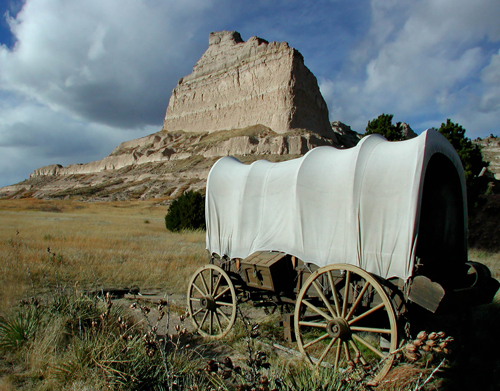
Scott's Bluff, Nebraska

We have fallen heirs to the most glorious heritage a people ever received, and each one must do his part if we wish to show that the nation is worthy of its good fortune…Theodore Roosevelt

Who would have the temerity to question Roosevelt’s love of country? Who would challenge the patriotism of the amazing woman who authored America the Beautiful? Can you imagine telling either to “love it or leave it?” Yet, in these polarized times, a time when fair and balanced are neither, these are precisely the charges they would suffer. Consider how this statement from Roosevelt would be treated by some in the press today:

To waste, to destroy, our natural resources, to skin and exhaust the land instead of using it so as to increase its usefulness, will result in undermining in the days of our children the very prosperity which we ought by right to hand down to them amplified and developed…Theodore Roosevelt

Or, what about this quote from Gifford Pinchot?

The earth and its resources belong of right to its people…Gifford Pinchot
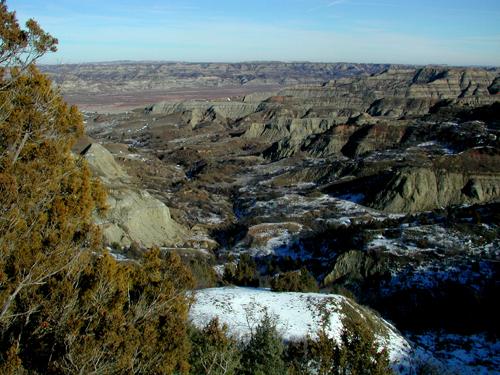
Little Missouri River, North Dakota Badlands

How would the words of these two stalwart Republicans be welcomed today? The judges may have changed, but not the principles of the ones being judged. There is a well-worn trail for us to follow, one blazed by these unequaled men and women of the past. The country may at times feel lost, but never should we. A life in conservation embraces a love of nation, a love of neighbor, a love of the wilds, a love of place. As our poet wrote,

O beautiful for heroes prov’d
In liberating strife,
Who more than self their country loved,
And mercy more than life.

Thank you, Katherine Lee Bates, for your wonderful song and beautiful life.

Here is Ray Charles’ live rendition of this soul-stripping, heart-charging song. Note that he begins with the third verse, not by accident. If this doesn’t drip with irony, with raw passion, you have no pulse.

Ted Lee Eubanks
12 Nov 2010
Fermata End-of-the-Year News

Let us begin with wishing all of you a happy holiday season. We doubt that any of us will forget 2010, as hard as we may try! Here hoping for a productive, peaceful, prosperous 2011.

We have recently posted a new podcast and two PowerPoints to our Podcast and Presentation page. The podcast is a recording of Ted’s October talk to a group gathered in Beckley, West Virginia. The conference, titled Reaching the Summit: Balancing Commerce and Nature in the New River Gorge Region, is one of the Conservation Fund’s Balancing Nature and Commerce workshops where Ted periodically speaks. We have posted Ted’s PowerPoint from that conference as well.

The PA Wilds continues to be in the news. The latest newsletter from the PA Wilds Resource Center is now available here.

Fermata’s Great American Trails has now created its third SmartTrail – the Tidal Delaware River Water Trail. The SmartTrail app is available for the iPhone, Android, and Blackberry platforms. More detailed information is available on the Great American Trails page in this blog.

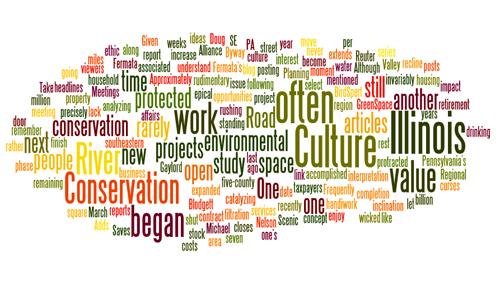
Fermata Wordle

We are often asked about the nature of our work (what do you do, exactly?). The answer is always cumbersome and incomplete. Now there is a web-based program that help us show what we do – Wordle. Wordle creates word clouds from text or a RSS feed from a website. This evening we ran the Fermata weblog through Wordle, and presto! here is a taste of what we do!

Fermata Word Cloud from Wordle

The Economic Value of Protected Open Space

There is a new report analyzing the value of protected open space in SE PA that should interest you. The study, commissioned by the GreenSpace Alliance and Delaware Valley Regional Planning, reports the following:

Approximately 300 square miles, or 14%, of the five-county region is protected open space. The study found that this area:

  • Adds $16 billion to the value of southeastern Pennsylvania’s housing stock – an average property value increase of $10,000 per household;
  • Saves local governments and taxpayers more than $132 million a year in costs associated with provision of environmental services such as drinking water filtration and flood control;
  • Helps residents and businesses avoid nearly $800 million in direct and indirect medical costs as a result of recreation that takes place on protected open space;
  • Generates more than $270 million in state and local tax revenue; and
  • Supports nearly 7,000 jobs.

The entire report is available here.

Let The Good Times Roll

The flight from Houston to LA is earth toned. From 30,000 feet the earth below is a Wheat Chex, a neatly gridded oil-and-gas field once prairie, bison, and surface life rather than subsurface petroleum. We will eventually suck this planet dry, every drop of oil and every whiff of gas. From my airborne vantage point Texans look well on their way in the Trans-Pecos.

After an interminably taxing campaign, the Americans who cared to vote have spoken. Billions were spent; a few listened. Simple messages of anger, hate, and desperation, endlessly repeated, inspired the susceptible (try 25% 65 and older) to give the keys back to rubes that wrecked the country in the first place. If you liked the profligacy of the past, laissez les bons temps roulez!

Not much surprises me. History shows that the American democracy is a two-step-forward, one-step-backward affair. Until the early 20th Century and the 17th Amendment our senators were “elected” by the state legislatures. Now there are a few boneheads in ascendency that would repeal the 17th Amendment and snatch the vote back from the American people. Americans have been able to ignore the most egregious inequities (slavery, for example), while vigorously debating the most trivial. What matters is the latest casualty on Dancing with the Stars. At times America has risen to astonishing heights; this is not one of them.

One of those transcendent moments dates to the earliest days of the 20th Century. Theodore Roosevelt and Gifford Pinchot have topographic maps strewn around the president’s offices, and the two are pacing about trying to identify those last open lands to be protected under the Antiquities Act before the senate exercises its “advice and consent” prerogatives. Their legacy lives on in our national parks, forests, and wildlife refuges, the most perfect manifestation of the American democracy. Now there are those in ascendency who would sell those lands, privatize the parks or shut the gates, and deny the American people what has been their birthright for over a century.

Isn’t it odd, even slightly queer, that American conservation, one of our most precious gifts to the world, found its voice first in the Republican Party? Now there are some in this same party, the party of Lincoln, who would undo Roosevelt, Pinchot, and Muir’s painstakingly crafted handiwork. Now there are some in this same party who would auction the lot to the highest bidder.

As I said, not much surprises me. Roosevelt, Pinchot, Muir, Bird, Chapman, Dock, McFarland, Rothrock, Edge, and Carson would not be surprised, either. Roosevelt relished the fight, the rare opportunity when a person can war for right against wrong, for good against evil, for what is fair against what is unfair. Conservation has always been intensely political rather than stridently partisan. Even Republican Richard Nixon recognized the deplorable condition of America’s air, waters, and wildlife in the late 1960s, and passed the most progressive suite of environmental laws in the world (NEPA, Endangered Species Act, Clear Air Act, Clean Water Act).

To protect America’s special places, to insure that our public land legacy will be inherited by future generations, we will need to transcend partisanship once again. Like-minded Republicans, Democrats, Green Partiers, and independents will be called to band together and confront those in the ascendency who care nothing for this American legacy, nothing for this American heritage, and nothing for the American space. Compromise in conservation is no more palatable or conceivable than compromise in civil rights, or free speech, or the right to worship, or the right to peaceably assemble. All of these rights, these values, are fundamental to the American character. I, for one, am willing to sacrifice none of them on an altar of greed, spite, myopia, and partisanship.

Abraham Lincoln, a Republican, said “I like to see a man proud of the place in which he lives.” Would Americans be as proud of their country without Yosemite, or the Grand Canyon, or Acadia National Park, or the Everglades, or Independence Hall, or the Statue of Liberty, or Gettysburg, or the Black Hills, or the Tongass National Forest? Would you be as happy (yes, happy is an American word, as in “life, liberty, and the pursuit of happiness”) in your skin and community without parks, libraries, trails, greenways, scenic byways, museums, or sanctuaries?

If not, if you cannot fathom life without having the riches of culture, history, or nature within arm’s reach, if you cannot imagine sacrificing any of these for personal gain or partisan greed, then accept that all are at risk without your active political engagement and effort. Conservation is a calling, one that views all political parties with skepticism and trepidation until good intentions are proven. At this critical juncture, this defining moment in the American experiment, conservation is calling again. I wonder who hears, and who will answer.

Ted Lee Eubanks
7 November 2010