We are in Nara, in the Mikasa roykan within the Nara Koen (Park). We are well above the valley that holds the city, surrounded by forest, deer, and silence. Given the tourist bustle of Kyoto, I welcome this peaceful interlude.
Before I regress and try to bring my travel accounts current, I must tell you about last night’s dinner. On this trip I have noticed similarities between Cassady and Virginia. The two share eyes, cheeks, and noses. They love each other’s company, and will spend the day sifting through shop after shop. And, they share laughter.
Cassady and Virginia do not just guffaw. They are choked by diaphragm-paralyzing paroxysms, incapable of communicating to the sober minded what they find so amusing. When they are finally able to breathe and speak again, the joke is a pale imitation of the laughter witnessed. With Cassady and Virginia, the fun is in watching how they react to a joke, not in hearing the joke itself.
Cassady is also like her mother and Japanese grandmother, marrying their dry humor and reserve with the American brashness and bravado of her father. She is a perfect amalgamation of the best of the two countries, and a delight to be around. I treasure the moments we share.
Now to retrace our steps. If you recall, after Okinawa we continued to Nagasaki and Hiroshima. I believe that I delved into the bomb issue in my Nagasaki account, and, to be honest, I have little interest in doing the same with Hiroshima.
Yet the two cities illustrate a challenge that I face in my work. Nagasaki and Hiroshima are known, at least outside of Japan, for one defining moment in their histories. Yet both have complex (and fascinating) histories and cultures that reveal more about Japan than the tragedies of one war. Consider the following.
In the mid-16th century Portuguese missionaries (including Saint Francis Xavier) arrived in Japan and began their missionary work throughout Kyushu. As interest in Christianity grew (along with the arrival of firearms), the feudal lords became increasingly concerned about their restless masses. Christians were publicly crucified in Nagasaki. Christianity became a capital offense, foreigners were expelled, and for over two centuries Japan closed itself to the outside world. Japan became the North Korea of the Victorian age.
Closed, except in Nagasaki. The Japanese ejected the Portuguese, but allowed the Dutch to maintain trade relations since they were far more interested in making money than converts. The Dutch, however, were sequestered on a small island specifically constructed for this purpose in 1636 – Dejima. Only through Dejima did Japan maintain contact with the world. This exclusivity remained intact until 1857 and the opening of Japan and the Meiji Period. Soon other ports eclipsed Dejima in popularity, and by 1902 Nagasaki had reclaimed the island and reconnected Dejima to the mainland.
In 1952, however, Nagasaki began acquiring the private lands in and around Dejima in hopes of restoring the Dutch trading post. By 2001 the land had been acquired, and the restoration began. Now there are ten buildings that have been reconstructed, and visitors can experience what was once the only contact between Japan and the western world.
Next we visited the Koshi-byo, a Confucian temple constructed by the residents of Nagasaki in 1893. The grounds of the temple also house the Chinese History Museum, with an impressive display on loan from the Chinese government. In the museum there is a splendid ivory carving of a Happy Buddha surrounded by children.
We ended the day at Glover Garden. After the reopening of Japan a Scotsman, Thomas Glover, chose Nagasaki as the place to make his fortune. He introduced the steam locomotive to Japan, modernized coal mining, and began the Kirin beer company. This garden contains his former mansion, as well as a number of trade-related buildings from that era. There are statues of both Puccini and Madame Butterfly in the garden, since Puccini set his famous opera in Nagasaki.
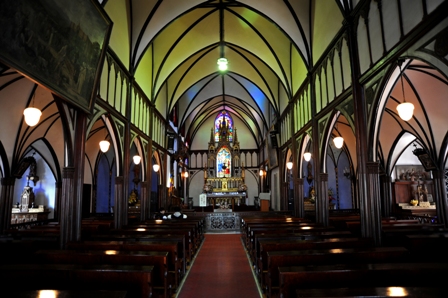
Adjacent to the Glover Garden is the Oura Catholic Church, constructed in 1863 to commemorate the 26 Christians crucified in 1597. According to the literature this is the oldest Gothic-styled building in Japan. As I entered the church I found myself curiously at peace, at home. I am certain that Christian traders must have felt the same so far from their homes. One does not have to be particularly religious to feel a connection to kindred spirits while in a foreign land.
How ironic that the one city in Japan where the cultures mingled (Christian, Confucian, Buddhist, Shinto) would be the target of the second atomic bomb. Even more wry (particularly for Nagasaki) is that the US military had chosen Kokura as the primary target, but bad weather forced Bock’s Car (the B-29 carrying the bomb) to a secondary target – Nagasaki.
But isn’t that war?
War is madness. War is a boda de sangre, with victim and victimizer fated to seal the marriage in the final bloodletting. For this reason war must be avoided. Once engaged, sanity, logic, and love fall victim to madness, passion, and hatred.
My opposing war (all war) is neither political nor religious. My opposing war is not naïve (trust me, I sincerely believe that there are bad people in the world). My opposing war is recognizing a fundamental flaw in the human soul. My opposing war is knowing that once unleashed the dogs of war are impossible to cage, and only calm once satiated with the blood of innocents.
Ted
22 Mar 2010