
My next stop is Harrisburg, where I speak to the Pennsylvania Parks and Forests Foundation awards dinner this evening.
Ted
4 May 2010
My next stop is Harrisburg, where I speak to the Pennsylvania Parks and Forests Foundation awards dinner this evening.
Ted
4 May 2010
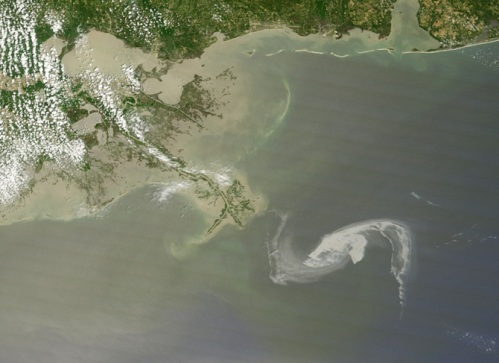
This is not new for us on the upper coast. In 2005 the BP refinery in Texas Coast exploded, killing 15 workers. BP received a record $53 million fine for safety violations. BP agreed that costs were a major factor affecting safety measures at the plant.
AP has reported that prior to this most recent event,
BP suggested in a 2009 exploration plan and environmental impact analysis for the well that an accident leading to a giant crude oil spill — and serious damage to beaches, fish and mammals — was unlikely, or virtually impossible.
The plan for the Deepwater Horizon well, filed with the federal Minerals Management Service, said repeatedly that it was “unlikely that an accidental surface or subsurface oil spill would occur from the proposed activities.”
The company conceded a spill would impact beaches, wildlife refuges and wilderness areas, but argued that “due to the distance to shore (48 miles) and the response capabilities that would be implemented, no significant adverse impacts are expected.”
The potential impact on the ecology of the Gulf Coast is catastrophic. The effect on coastal communities is unimaginable. Following in the footsteps of hurricanes Katrina, Rita, and Ike, the Gulf Coast is hardly prepared for another major disaster. Bolivar and Galveston, for example, are still reeling from Hurricane Ike 18 months ago.
As this tragedy unfolds, I will try to keep posted the links that appear to me to be covering the story most accurately. Language is a tricky thing, and slight changes in wording can dramatically alter the meaning of a statement or story.
Here is an example. The press continues to use the word “spill” to characterize this debacle. This is no spill, it is a blowout. The blowout preventer failed, and now there is unchecked oil and gas jetting to the surface of the Gulf from over a mile down. If officials are unable to recap this well, it will continue to flow until the pressure in the reservoir diminishes to a point where the oil and gas cannot no longer escape.
Ted
NASA Imagery
Field and Stream
Audubon’s Frank Gill’s editorial
The next few weeks are dominated by travel. There is nothing like spring to entice one outside. This week I am in Scott County, assessing sites for a heritage tourism analysis. We are working with Carolyn Brackett, a Senior Program Associate with the Heritage Tourism Program, National Trust for Historic Preservation. After returning to Texas on Thursday I will be in Galveston, trying to finish dismantling the Houston office.
On Sunday I fly to Pittsburgh, and then spend next week in Pennsylvania. I am speaking at Pennsylvania Environmental Council’s Marcellus Shale conference Monday. I then travel to Harrisburg on Tuesday to attend the Pennsylvania Parks and Forests Foundation’s annual awards dinner that night. PA DCNR parks recently won the gold medal for being the best state park system in the nation, and that night we will all celebrate their success.
I will continue on to Philadelphia the following morning, and I will work the remainder of the week in Fairmount Park. The last time I visited Philadelphia we were hampered by the remainder of a blizzard, and it will be wonderful to see the park facilities exposed.
Finally I will fly to Chicago on Sundayt, and then drive to Valparaiso (Indiana) for a couple of days work on Indiana Beyond the Beach. We are about to unveil a number of new products regarding the BTB Discovery Trail, so stay tuned. I will blog from the road as I travel these next weeks.
Ted Eubanks
26 April 2010
Daily text messaging among American teens has shot up in the past 18 months, from 38% of teens texting friends daily in February of 2008 to 54% of teens texting daily in September 2009. And it’s not just frequency – teens are sending enormous quantities of text messages a day. Half of teens send 50 or more text messages a day, or 1,500 texts a month, and one in three send more than 100 texts a day, or more than 3,000 texts a month. Older teen girls ages 14-17 lead the charge on text messaging, averaging 100 messages a day for the entire cohort. The youngest teen boys are the most resistant to texting – averaging 20 messages per day.
Text messaging has become the primary way that teens reach their friends, surpassing face-to-face contact, email, instant messaging and voice calling as the go-to daily communication tool for this age group. However, voice calling is still the preferred mode for reaching parents for most teens.
The National Marine and Fisheries Service (NMFS) has authority for enforcing the Endangered Species Act (ESA) regarding marine animals, include sea turtles and marine mammals. If you see a violation, immediately contact the 24-hour NMFS Enforcement Hotline at (800) 853-1964. You may also call the U.S. Coast Guard Hotline at (800) SAVE-FISH.
Texas has its own list of endangered and threatened species in the state. Contact Texas Parks and Wildlife at 1-800-792-GAME (4263).
The U.S. Fish & Wildlife Service has jurisdiction over the remaining endangered species, those protected by the Migratory Bird Treaty Act, and those protected by the various federal-level game laws. You can assume that virtually any bird seen at San Luis Pass is protected, or is regulated through state and federal game laws. Contact the USFWS at the following address:
Office of Law Enforcement
P.O. Box 329
Albuquerque, New Mexico, USA 87103
Phone(505)248-7889 Fax:(505)248-7899
The Texas General Land Office controls ownership of lands protected for the citizens through the Texas Open Beach Act. The US Army Corps of Engineers (along with the EPA) is responsible for regulating wetlands.
Finally, contact the City of Galveston and let them know about your disgust with their disinterest. Galveston is about to have a city election, and there will be a new mayor. For the time being, though, you can contact Mayor Thomas directly.
Ted Eubanks
17 April 2010