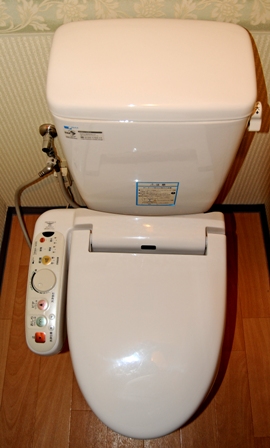
Before I address Hiroshima, let’s return to toilets. My granddaughter’s camera crapped out in Hiroshima, so I promised to buy her a new one. We sauntered over to Big Camera (like Best Buy in the states), and she quickly found one to her liking. While waiting to pay, I noticed the techie toilet display on the wall next to the checkout. I know that many of you are not buying into this Japanese toilet thing, but take a look at this one wall.
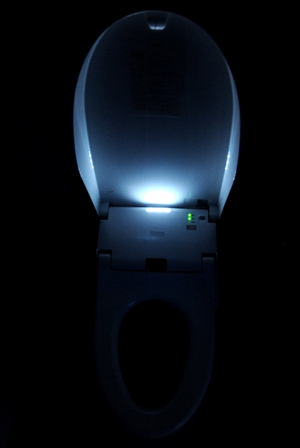
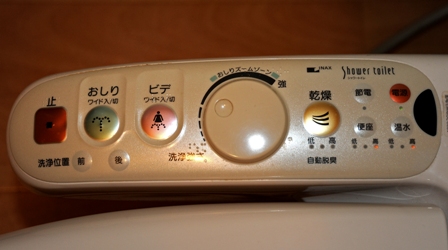
After a quick Shinkansen ride to Kyoto, we checked into a marvelous boutique hotel – Mume. Once ensconced in the room, I walked into the bathroom to be greeted by a self-elevating toilet seat illuminated with an LCD landing light. Then I noticed the control panel on the wall next to the toilet. I will let you read the various settings, but consider the implications of “Posterior Cleansing.”
If you are my age you grew up with the bomb. As a child I would peer out the window of my Dad’s Chevrolet as we drove to my grandparent’s home in Paris (Texas) and wonder if any of the summer clouds billowing in the sky signaled an attack (Dad! That one looks like a mushroom!). In October 1962, at Landrum Junior High in Houston, we drilled daily during the Cuban Missile Crisis. The siren would howl, and we would drop under our desks and cover our heads in expectation of the big blast.
During that frightful week the school administration had the bright idea that we would have a drill to test evacuating the school and going home. We were not to actually go home, but to make our way to our transportation of choice (bus, car, bike) and then return to class. My friend Kenny Farris didn’t get the message, and once on his bike he high-tailed it back to the neighborhood.
If you are my age, you grew up with the bomb.
But the bomb never came. We drilled. We feared. We watched Nikita Khrushchev pound his shoe on his desk at the UN and promise that he would bury us. Khrushchev faded, the Soviet Union dissolved, and the bomb never came.
Except there are two cities where the bomb did come, and I am visiting both. In fact, I am sitting in my hotel room tonight, sipping a cold glass of sake in Hiroshima. I am drinking to those who died, to those who fought, and to those who knew (such as Leo Szilard), that once the bomb fell children everywhere would see mushrooms in summer clouds.
I never expected to live to be 30. Now I will be 60 in a few days, and I have a granddaughter who is 21. She is both Japanese and American, and we are, together with her grandmother, trying to grasp the meaning of Nagasaki and Hiroshima within the context of our family. Our family is both victor and vanquished, and this trip is about how we, as a family, reconcile the two.
Reconciliation, for us, began in Nagasaki. We arrived after a two-hour express train ride from Fukuoka, and we settled into one of the famous ryokans in the region, Sakamoto. After years (decades, actually) of traveling in Japan there is no comfort I appreciate more than a traditional ryokan. As Cassady and Virginia shopped, I relaxed in our room and worked on a couple of projects hanging over my head.
My work continued the following morning, but that afternoon we joined a formal bus tour of the sites that we, as a family, wanted to see. This is not a tour for the squeamish. This is a tour for those who want to grab Nagasaki by the neck and throttle it until the truth shakes loose. Like paregoric, the truth is best dosed in a single gulp. The tour began at the Nagasaki Atomic Bomb Museum.
Nothing here is new. In school we were shown the effects of the bomb, watching grainy black-and-white movies with banshee winds sweeping buildings into dust. But being here, at the exact spot where so many suffered and died, is different. Nagasaki is not a movie. Nagasaki is not a myth. Nagasaki is a flesh-and-blood community, an amalgamation of people whose parents and grandparents were victims of the unbridled insanity of war.
Before I move forward, let me make one side comment. I am not questioning Truman’s decision or the morality of the dropping of the atomic bomb. As one then not yet born, that is not my right.
Yet consider the following quotes from two who were. Paul Fussell, the educator and writer, sat in Okinawa in 1945 waiting for what appeared to be the inevitable invasion of mainland Japan. Upon hearing of Hiroshima, Fussell recalled being overcome with the realization that “we were going to live. We were going to grow up to adulthood after all.” Fussell also wrote that the “worst thing about war was the sitting around and wondering what you were doing morally.”
Now consider this quote from Keijiro Matsushima; “I did not come here to blame. You veterans did your job. But at the same time, what you dropped on Hiroshima and Nagasaki was very horrible. Now, if possible, please, just a drop of your tears, and a prayer that this never happens again.”
We came to Nagasaki to shed tears and to pray that this never happens again, to our family or to yours.
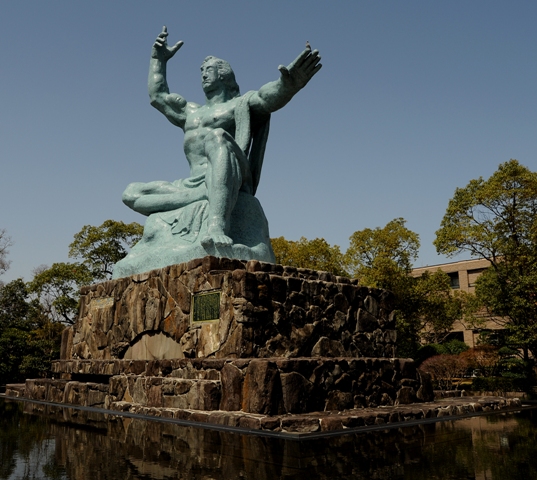
The Nagasaki Atomic Bomb museum is raw, brazen, at times grotesque, and yet sympathetically elegant. As you enter you are confronted with the moment: August 9, 1945, 11:02 AM. In an instant, between 40,000 and 80,000 human beings were irradiated, incinerated, and, in many cases, vaporized. These people, going about their lives as we do ours, were carbonized.
The question of guilt or innocence is moot. Yes, Nagasaki and Hiroshima were military targets in that Mitsubishi operated armament plants in both. Yes, there were around 2000 school age children who were conscripted to work in the Mitsubishi armament plant in Nagasaki who died in the bombing. These children were “conscripts” (as were around 10,000 Koreans), yet they died among the “guilty.” I am assigning no blame. Yet the voices of the dead, the voices of the innocent, deserve a hearing.
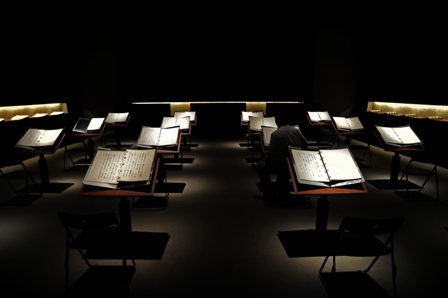
The Nagasaki Atomic Bomb Museum, in part, speaks for the dead. As you enter you hear the tick-tock of a clock, measuring the moments before the blast. The first image is the famous film of the detonation, taken as the American bombers circled Nagasaki before returning to base. Across from the video is a clock from that city, stopped at 11:02. By 11:03 thousands were dead.
The remainder of the museum houses the detritus from that moment, and attempts to explain the process by which Nagasaki came to be the target from the world’s first plutonium bomb – Fat Man. As many of you know, my company is involved in interpretation, the art of communicating these iconic resources and events. I am of the camp that believes that “fair and balanced” is neither. No interpretation is without the biases or opinions of the writer. A simple choice of one word can shade the entire meaning of a story, an article, or an interpretive sign. Words such as “victim,” for example, are loaded. Some words, such as “gay,” have evolved in recent times. What about the word “terrorism?”
Here is another example. In the English language version of the Nagasaki Atomic Bombing Monuments pamphlet, there is this section:
Soil stratum of ground level at the time of the atomic bombing. This soil stratum contains fragments of roof tiles and bricks, scorched soil, melted glass and other objects damaged in the explosion. It is preserved in order the tell of the atrocity of the atomic bombing.
Atrocity? See how one word, perhaps, in this case, a translation glitch, can color the meaning of an entire narrative? Replace atrocity (implying a crime) with tragedy and the message is dramatically changed. Touchy stuff, this interpretation business.
From my perspective, the Nagasaki Atomic Bomb Museum offers a reasonably balanced approach to the event with one glaring exception. There is no discussion of the role of the Japanese military or its leader, Hirohito, in the events that led to August 9, 1945, 11:02 AM. There is a triangular display of all people who had a role in the development and use of the bomb (Roosevelt, Churchill, Einstein, Neils Bohr, Robert Oppenheimer, even Hitler and Stalin), but Hirohito is nowhere to be seen. And what about Yoshio Nishina, a former student of Bohr’s, ordered in April 1941 to establish the Japanese atomic bomb project? Japan, Germany, Britain, Russia, and the United States were all chasing the bomb. Isn’t that part of the Nagasaki story as well?
History is a complex interlacing of conflicting, contradictory, convoluted, and confusing events that shed light, and often shadows, on what we experience today. To apply logic to the past is as nonsensical as trying to apply logic to the present. Nowhere is this more apparent than in the story of war. War is insane. The decisions of governments in war are insane. Honor the dead, celebrate the heroic, yet pray that humankind finds its way past war to loving one’s neighbor.
I came to know Japan through Seth’s wife and family, and now our three grandchildren. I have come to respect the culture, the history of these people, and the incomprehensible faith that allowed them to rebuild after being so totally undone. What has reconciled our family, with fathers and grandfathers once embroiled on opposite sides in a world war, is love.
Let me begin with an apology. You did not expect an article on toilets, I know. But after Nagasaki and Hiroshima, I decided to interject some humor, some levity, before I address issues about which it is impossible to laugh.
The Japanese know high-tech. But of all of their technological contributions, nothing comes close to their bathrooms.
Here is my first example. I travel constantly, and probably spend 100 nights or more annually somewhere in some hotel working on some project. Among my pet peeves is the bathroom mirror that fogs after I shower and before I can shave. Invariably I am scrambling for a dry towel, then trying to wipe away the moisture before it reappears. Of course it fogs again as soon as I place razor on skin.
In Japan, they have developed a bathroom mirror that has a heating element in one corner that prevents the mirror from fogging. No matter how obscured the remainder of the mirror might be, this corner is always fog free. Score one for the Japanese.
And what about a bathtub that fills itself, then plays Jesu’ Joy of Man’s Desiring when ready for you to immerse? Score two for the Japanese.
The Millennium Falcon of Toilets
Yet nothing (NOTHING) approaches the panache of a Japanese toilet. This is the Millennium Falcon of toilets, Hans Solo’s throne. At home I only have to worry about pushing a handle down. In Japan, to use the toilet is as nerve-racking as programming a DVR. These toilets don’t just flush (normally my only concern). They heat, spray, rinse, dry, and buff. A Japanese toilet is a car wash for your derriere.
I would love to take one home, but I would have to completely rewire and replumb my house. Score three for the Japanese and their toilets. They have elevated a simple biological function to high-tech nirvana.
America imports oil from Saudi Arabia, cars from Japan, wine from France, shrimp from Viet Nam, coffee from Costa Rica, jalapeños from Mexico, and even toothpicks from China. We have perfected consumption, and the world feeds our insatiable appetite for stuff.
In return, America exports pop culture. No matter where you might wander, blithely expecting to be swallowed in a culture unlike your own, your first meal likely will be accompanied by the viral voices of Michael Jackson or Lady Gaga.
A couple of years ago I traveled with a group organized by Jerry Adelmann of Openlands to work in three World Heritage Sites in southern Yunnan. This is end-of-the-road China, hugging the border with Burma. Enjoying an evening in a pizza joint in the walled city of Dali, we were circled by young Chinese who could have effortlessly blended in New York, Paris, or Tokyo. Fast food, rap music, IPods, cell phones, and reality TV will be our legacy, I suppose.
You can no more escape American culture in Japan than you can in America. A few minutes ago we arrived in Nagasaki, and while walking through the train station we were met by American pop music blasting from every pore in this city. Consider the irony for a moment. We are in Nagasaki, for God’s sake, and our Japanese hosts effortlessly embrace an Americanized culture.
Please don’t mistake these observations for cheap America bashing. I have seen more of America than virtually anyone I know, and my love affair with our country is unquestioned. I am constantly reminded that we also gave the world pragmaticdemocracy, and that contribution will (hopefully) remain our bequest to future generations such as my granddaughter’s.
I am not referring to the jingoistic democracy that has been imposed through misguided nation-building (or unraveling) in recent years. I mean the democracy that grows organically through our examples of selflessness and good works (consider the Occupation here, for example, or the Marshall Plan in Europe).
Let me offer a case in point. No single issue has haunted America since its founding as has slavery. Slavery is the one irreconcilable impasse that the founders failed to resolve in Philadelphia, passing it on to future generations to address. America invested over 700,000 lives in a Civil War to finally make good on the promise of liberty for all, yet only in my lifetime in the Jim Crow South have our black citizens, our neighbors, been invested with the rights enjoyed by the rest of us from the beginning.
At this moment we are led by a president who is himself an African-American, married to a woman who is the direct descendent of African slaves. According to a recent article in the NY Times, “In 1850, the elderly master of a South Carolina estate took pen in hand and painstakingly divided up his possessions. Among the spinning wheels, scythes, tablecloths and cattle that he bequeathed to his far-flung heirs was a 6-year-old slave girl valued soon afterward at $475.”
“In his will, she is described simply as the “negro girl Melvinia.” After his death, she was torn away from the people and places she knew and shipped to Georgia. While she was still a teenager, a white man would father her first-born son under circumstances lost in the passage of time.”
“Melvinia Shields, the enslaved and illiterate young girl, and the unknown white man who impregnated her are the great-great-great-grandparents of Michelle Obama, the first lady.”
Let that sink in for a moment. Where else in the world would this be possible? Michelle Obama’s grandfather was a postman, and her father worked as a pump worker at the City of Chicago water plant. Barack O’Bama’s paternal grandfather was a Kenyan mission cook and herbalist, and served time in a British prison for being involved in the early African liberation movement (as well as where he was tortured). The president’s father served as a government economist in Kenya.
In contrast, George W. Bush’s grandfather, Prescott Sheldon Bush, served Connecticut in the U.S. Senate from 1952 until January 1963. His father, George H.W. Bush, followed Ronald Reagan as the 41st president of the United States.
A black American president is as likely as a Jew being elected leader of Iran, or an Aboriginal as prime minister of Australia. Yet it did happen in America, and as a peaceful blessing of a stable democracy. I am writing, at this very moment, in Nagasaki, a city utterly obliterated in WW II as the result of a despotic government, led by an emperor thought to be divine, willing to sacrifice the blood of its citizens to the last drop.
Our country, in moments of greatness, finds a way to rise above its limitations, its prejudices, and its hatreds. Of course we have every right to criticize the policies and actions of our presidents. The first amendment to the constitution guarantees that right. In fact, let me remind you of the entire text of the First Amendment:
Congress shall make no law respecting an establishment of religion, or prohibiting the free exercise thereof; or abridging the freedom of speech, or of the press; or the right of the people peaceably to assemble, and to petition the Government for a redress of grievances.
Those who would slander and personally attack our president or his wife because of their ethnicity or color damage our democracy, I believe. The “birthers” who have questioned his citizenship and those who have alluded to his Islamic heritage (which, even if a practicing Muslim, would be his constitutional right as protected by the Establishment Clause of the First Amendment), besmirch the promise of our democracy so needed by much of the world. Of course these people have to right to express themselves under the protections of this same First Amendment, just as I have the right to call them misguided, bigoted fools.
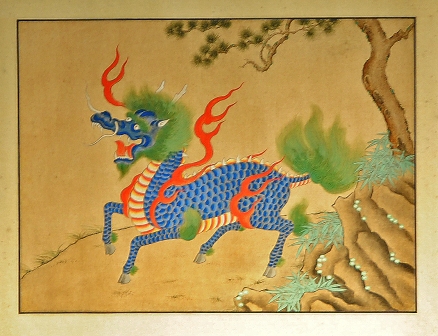
Dragon print, Shuri-jo, Okinawa
I am ahead of myself, though. On our third day in Okinawa we left the Marriott (talk about American culture) and wandered back south toward Naha in search of this island’s cultural soul. There are several World Heritage Sites on the island that have been restored to honor the Ryukyu past. We first visited Zakimi-jo, one of the citadels built during the Ryukyu era to defend the interests of a local lord. The remnants of the walled fortress offer an unobstructed view across the island, from the East China Sea east to the Pacific. Given Okinawa’s importance to trade between China, Korea, and Japan during the Ryukyu, these elevated vantage points were invariably sites of forts and fortresses such as Zakimi-jo. In the small museum there were several examples of ceramic funereal urns, an important tradition to the Ryukyu. After a period of years the Ryukyu would cleanse the bones of their loved ones, and place them in these urns.
We left 15th Century Ryukyu Japan to beam up to the 21st Century and the Kadena AFB. After the war the U.S. military established several bases on Okinawa, Kadena among them. These bases have been sources of tension here for decades, and the strain still influences politics throughout the country. Many here would like for the U.S. military to leave, or, at least, to consolidate the bases. There are others who are adamant that the U.S. should stay. Every time North Korea lobs another missile across Japan, or another U.S. sailor or soldier commits a crime while off base, the issue flares once again.
We stopped across from the base and climbed to the top of an observation tower to view the base. What fascinated me were the small farms and gardens that locals were cultivating at the base of the sound baffles that border the runway. As I said before, no land goes to waste in Japan. And what about Tommy Lee Jones on the vending machine in the lobby? The boss?
Mr. Iwana next led us to one of his favorite restaurants in the village of Kadena. This soba shop is the archetypal Japanese cubbyhole, with three tables and two additional in the tatami room. The owner/chef specializes in Japanese-style buckwheat noodles made daily. He is also a jazz buff, and one wall of the café houses his impressive collection of vinyl albums. There we slurped our noodles to the music of Coltrane and Monk.
As with so much of Japan, our final destination is significant at multiple levels. Shuri-jo is the finest example of Ryukyu on the island. This extensive castle is still in the process of being restored after being obliterated during WW II. The interpretation in Shiri-jo, sadly, failed to mention precisely why the complex had been destroyed during the Battle of Okinawa.
Underneath the castle, as much as 100 feet below ground, were extensive tunnels and caverns that housed the Japanese military commander, Ushijima, and at least 20,000 of his troops. The American military relentlessly bombarded the Shuri site, with little impact on the Japanese. These caverns today are closed to the public, although there are access points if one knows where to look (such as Mr. Iwama).
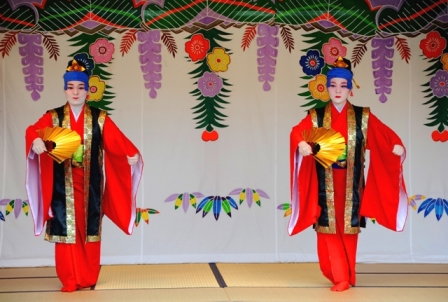
We also were treated to a dance performance within the castle grounds. According to my granddaughter, the dance consisted of elements of both traditional Japanese dance as well as that most likely attributable to the Ryukyu. Whatever the genre, I thoroughly enjoyed the slow-motion, expressionless dancers in their splendid costumes.
Next we fly to Fukuoka, and then catch the express train to Nagasaki. We will spend three nights at a famous ryokan, our first chance to relax for more than one night in the same hotel.
We began the day in Naha with lattes, a pastry translated as “the bomb,” and a skip across the parking lot to a tiny religious site tucked in by the port. As part of the Ryūkyū kingdom until “assimilated” by Japan during the Meiji, there are celebrated remnants of Ryūkyū religion here. However, my uneducated eye can’t tell Ryūkyū from Buddhist from Shinto, although the differences between these Okinawan shrines and those on Honshu are noticeable. We came upon a group of older people placing offerings at the shrine, with the woman reading from a printed script. Apparently there is an attempt here to resurrect the Ryūkyū culture as we see in Hawaii with its native resurgence.
For our first jaunt of the day we drove south to the tip of the island and the Okinawa Prefectural Peace Memorial Museum. The park complex is constructed at the site where the Japanese military finally surrendered to the Americans at the end of the Battle of Okinawa.
That horrific bloodletting lasted 82 days, with a price of at least 200,000 lives (at least half of them Okinawan civilians). The park and museum quietly reinforce the idea that war is madness, and you cannot leave here without that notion made brutally clear. Particularly moving were the walls with the names of the dead, a reflection of (and inspired by) the Viet Nam war memorial in Washington D.C. The park also reminded me of the International Peace garden that straddles the U.S and Canadian border in the Turtle Mountains, with its manicured gardens and tall spire at the end of a mall.
One cannot visit Okinawa and escape the shadow of the war. My father, who is alive and well at 85, served on a DE on the way to Okinawa to prepare for the invasion of Japan. The war, in effect, came to an end here, and the Okinawans themselves paid most dearly for being precisely at the wrong place at the wrong time. The exhibits in the museum document their sufferings, culminating in a room with nothing but the written remembrances of Okinawans who survived the hell of that battle.
The history of war is most often written as a series of discrete events, memorializing battles between well-defined enemies and celebrated leaders. We honor the warriors, and deify their commanders. What is lost is such a narrative are the lives of the countless civilians who are victimized by war. Where are the people who simply wished the war would go away; common people who are displaced, suffer, and die in these conflagrations? Okinawa, Tokyo, Hiroshima, Nagasaki, Dresden, Hamburg, Nanking, Manchuria, the World Trade Center, and Baghdad are among the countless killing fields of peoples who committed no crime, and who wished only for what our founders demanded as “life, liberty, and the pursuit of happiness.” Nowhere is that truth more evident than Okinawa.
After a quick bowl of soba (Okinawan style, with a thicker noodle), we began the trek to the northern end of the island. Once past the urban maze of the south (and Naha) we soon were enveloped by small farms and villages; the Okinawa I wanted to experience for myself. Fields of corn and sugar cane, bitter melon vines, the bristling tops of pineapples plants, and the curious bush-topped stalks of papayas painted the landscape.
Only in the hinterlands did we also begin to see native Okinawans, people whose Mongol heritage comes through in their shorter stature and darker skin. Many had features that reminded me of Koreans, and, during the Ryūkyū era, Okinawa, Korea, and China enjoyed extensive trade. As I have seen throughout Japan, these farms are models of manicured care. No square inch goes to waste, and their postage stamp farms are meticulously tended. How nice to spend an afternoon driving through rural Okinawa without seeing the detritus of everyday life (abandoned double wides, half-stripped automobiles, roadside McDonald hamburger wrappers) that characterizes much of the rural Texas countryside (particularly the coast).
Mr. Iwama, our dear friend and tour guide, wanted to show us the Kesaji mangrove forest in the village of Higashi. This small park had a nice boardwalk through the mangroves, and a bustling kayak rental business that filled the waters with shrieking young girls this Saturday afternoon.
For my birder friends, I did see a few familiar species, although this trip is not one where birding is taking the front seat. I have deprived my family too many times of my attention and presence during these types of trips as I sauntered off chasing birds, so I am trying to make up for lost time. I did see familiar birds such as Blue Rock Thrush, Yellow Wagtail, Chinese Bulbul, and Japanese Whiteeye. As we walked along a stream at Kesaji we were treated to a Common Kingfisher whizzing by in an iridescent azure blur.
After our mangrove hike we drove a short distance to the Marriott Okinawa resort, where we treated ourselves to a night of tourist pampering. Mr. Iwama and I began the evening with a couple of glasses of the local rice drink – Ayamori. Served over ice, Ayamori is sake on steroids. While sake is brewed, Ayamori is distilled (think about the difference between pulque and tequila). Dinner at the hotel consisted of many local dishes, including a salad of umi budo (seaweed that resembles strands of green grapes), kimchee, beni imo (the Okinawan purple yam), and another Okinawan specialty, shima tofu.