Daily text messaging among American teens has shot up in the past 18 months, from 38% of teens texting friends daily in February of 2008 to 54% of teens texting daily in September 2009. And it’s not just frequency – teens are sending enormous quantities of text messages a day. Half of teens send 50 or more text messages a day, or 1,500 texts a month, and one in three send more than 100 texts a day, or more than 3,000 texts a month. Older teen girls ages 14-17 lead the charge on text messaging, averaging 100 messages a day for the entire cohort. The youngest teen boys are the most resistant to texting – averaging 20 messages per day.
Text messaging has become the primary way that teens reach their friends, surpassing face-to-face contact, email, instant messaging and voice calling as the go-to daily communication tool for this age group. However, voice calling is still the preferred mode for reaching parents for most teens.
The National Marine and Fisheries Service (NMFS) has authority for enforcing the Endangered Species Act (ESA) regarding marine animals, include sea turtles and marine mammals. If you see a violation, immediately contact the 24-hour NMFS Enforcement Hotline at (800) 853-1964. You may also call the U.S. Coast Guard Hotline at (800) SAVE-FISH.
Texas has its own list of endangered and threatened species in the state. Contact Texas Parks and Wildlife at 1-800-792-GAME (4263).
The U.S. Fish & Wildlife Service has jurisdiction over the remaining endangered species, those protected by the Migratory Bird Treaty Act, and those protected by the various federal-level game laws. You can assume that virtually any bird seen at San Luis Pass is protected, or is regulated through state and federal game laws. Contact the USFWS at the following address:
Office of Law Enforcement
P.O. Box 329
Albuquerque, New Mexico, USA 87103
Phone(505)248-7889 Fax:(505)248-7899
The Texas General Land Office controls ownership of lands protected for the citizens through the Texas Open Beach Act. The US Army Corps of Engineers (along with the EPA) is responsible for regulating wetlands.
Finally, contact the City of Galveston and let them know about your disgust with their disinterest. Galveston is about to have a city election, and there will be a new mayor. For the time being, though, you can contact Mayor Thomas directly.
Texas boys and girls joyride their way across our beaches, leaving flattened wildlife and rutted beaches and dunes in their wake. Texas anglers, too sluggish to actually walk to the shore to fish, steer their pick’em trucks to the water’s edge where they can offload their beer and bait. Drive-by birders clamp their scopes to side windows and chase the birds from the comfort of air conditioning. All ignore who gets hurt.
Here’s who.
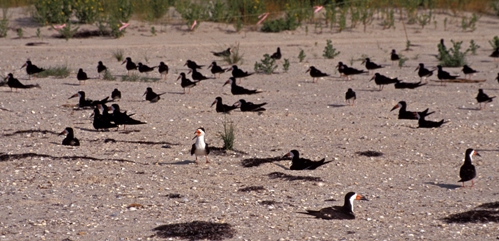
Black skimmers nest, when able, on the beach at San Luis Pass. They carve out a small depression in the sand where they lay their eggs. They nest colonially, so they are hard to miss. Black skimmer breeding colony
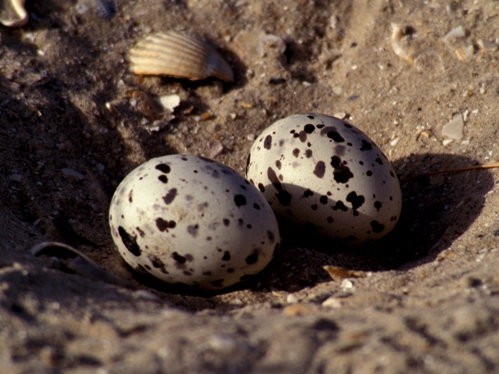
Of course the eggs are difficult to see in the nest itself. These birds nest in exposed areas, and therefore their eggs are patterned much like the sand and shell around them. Black skimmer eggs, San Luis Pass
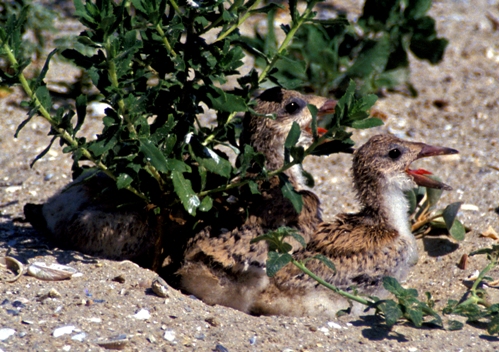
The young skimmers are most vulnerable as hatchlings (i.e., after hatching but before they can fly). Young skimmers are easy prey for raccoons, coyotes, feral cats, and ORVs. Skimmers will hide their young in the shade of any adjacent vegetation to keep them cool and safe. Black skimmer chicks, San Luis Pass
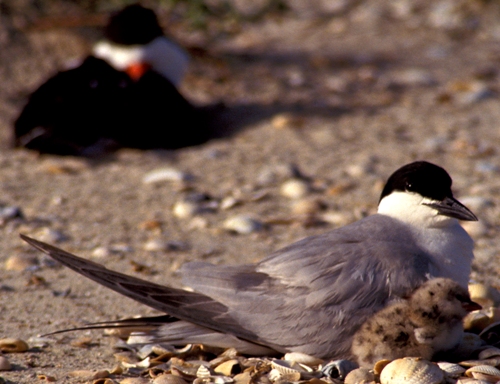
Skimmers are rarely alone in the nesting colonies. They are often joined by gull-billed terns, an uncommon breeder along the upper Texas coast. Gull-billed tern at nest, San Luis Pass
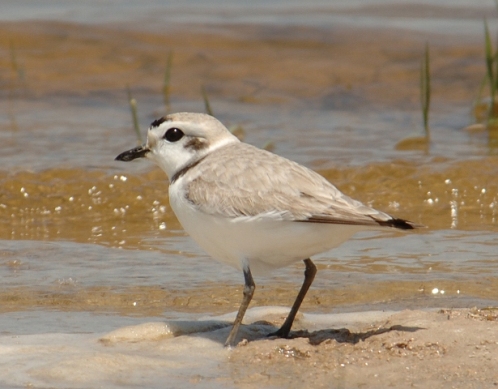
Shorebirds such as the snowy plover, Wilson’s plover, and willet will nest nearby. Snowy plover has only recent begun to recover from a population crash most likely due to increased beach traffic. Snowy plover
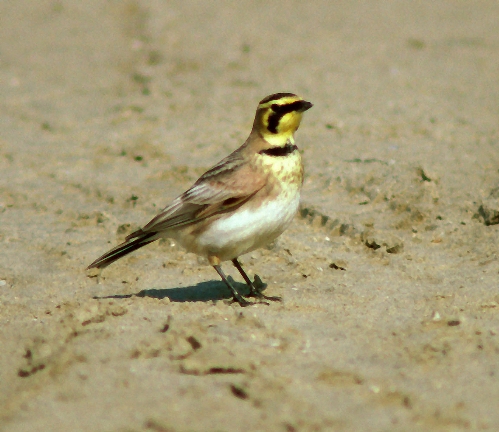
A few of the birds that nest here are unique to the region. The Texas horned lark is but one of numerous subspecies, but with its generous yellow wash about the face and head it may be the most attractive. Horned larks, too, nest here at San Luis Pass flats. Texas horned lark
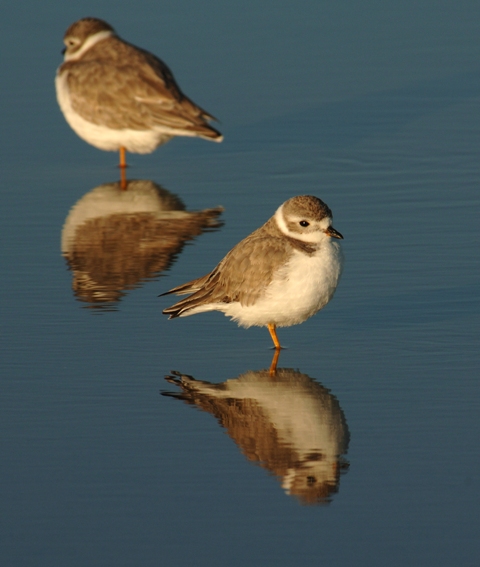
Some, like the piping plover, are threatened. Other wildlife species, such as Kemp’s Ridley sea turtle, are endangered. Yet all depend on San Luis Pass for some portion of their lives. Piping Plover, Galveston
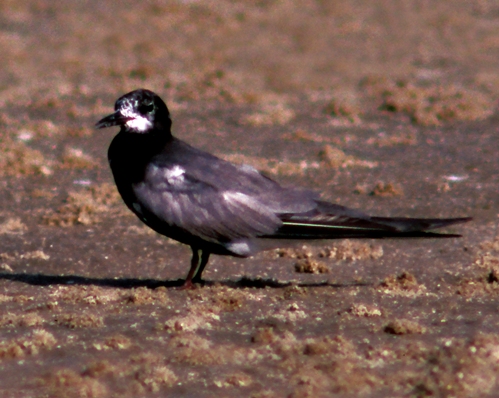
Many of the San Luis Pass species gather, at times, in immense aggregations. For example, after nesting many of the gulls and terns bring their young to San Luis Pass flats for the remainder of the season. In this way they only have to make short flights between their young and the waters where they feed. Some gather here after nesting far away. For example, the black tern is an inland tern that breeds throughout the Great Plains east through the Great Lakes. In late summer and early fall they stage at San Luis Pass flats, gaining weight and energy stores before making their migratory flight to the coast of northern South America. These staging flocks at San Luis Pass can be dazzling, with as many as 25,000 birds congregated on the sand flats and floating over the waters of San Luis Pass on a single day. Black tern, San Luis Pass flats
These are but a few of the species that are being decimated by the failure of the local, state, and federal governments to protect them. The laws are in place; the enforcement is absent. Galveston would rather prosecute one local birder who took it on himself to control the feral cat population than to police the area for which Galveston has jurisdiction, authority, and responsibility. Theodore Roosevelt, the greatest American conservation president, said that “surely our people do not understand even yet the rich heritage that is theirs…our people should see to it that they [America’s treasured landscapes] are preserved for their children and their children’s children forever with their majestic beauty unmarred.” San Luis Pass Flats is one of Galveston’s treasured landscapes, and complacency and ignorance are insuring its demise. San Luis Pass is marred. San Luis Pass is disintegrating.
There is nothing new in this saga. I first became involved in trying to protect this area in the 1980s, when the property had been sold to the Dugan family by the Resolution Trust Corporation. The original developer had defaulted during the S&L collapse (remember that fiasco?), and the Dugans had acquired the property at a bargain basement price. They immediately tried to limit vehicular traffic in the region, and the locals squealed. The city capitulated.
Later I became involved in San Luis Pass when the Dugans decided to sell to yet another development company,Centex. The new buyer wanted to restrict vehicular traffic on the beach, and I wanted to get the cars and trucks away from the birds and other wildlife. While some traffic has been eliminated near Point San Luis, the vehicles simply moved to the end of the island and the flats. Then Centex bailed (beginning to see a pattern?), and the property ended up being owned by Macfarlan Capital Partners and their management arm, Terramesa Resort Development. Traffic damage, San Luis Pass
These conservation battles have been fought for decades here. In the 1970s we fought against the George Mitchell development of Eckert’s Bayou, now called Pirates Cove. We argued (without success) that the dynamic nature of this landscape, and its vulnerability to storm surge, made it unsuitable for large-scale housing development. Until Hurricane Ike the building boom on the west end continued, each developer and buyer hoping, against hope, that a storm would not occur on their watch. All balanced on the bubble, praying that they could make their fortunes before time to go (and leave their messes for us to clean up). On 13 September, 2008, the bubble burst.
In the late 1800s heron and egret rookeries in the southeast were decimated by plume hunters. Women of fashion demanded ornate hats decorated with the plumes plucked from birds slaughtered for that reason alone. Roosevelt created the federal wildlife reserve system (wildlife refuges) by an executive order and a simple “I so declare it.” By the end of his presidency Roosevelt had protected acreage equal to about half of Jefferson’s Louisiana Purchase.
What is rarely mentioned in this otherwise rosy story is the opposition that Roosevelt, Pinchot, and others met every step of the way. The exploiters of nature will always fight against those who want nature preserved. Plumers fought restrictions against slaughtering herons and egrets. Market hunters chaffed at the initiation of the nation’s first game laws. Developers today oppose deeper set backs along Galveston’s beaches.
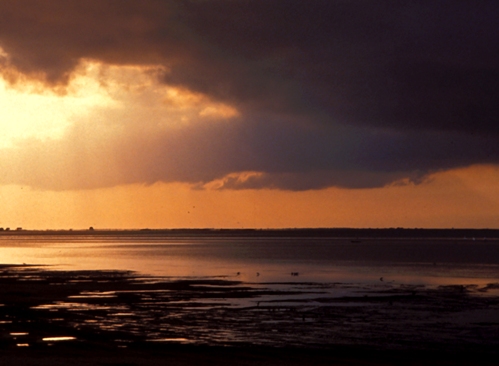
Gifford Pinchot, in The Fight For Conservation, popularized the notion of conservation. Pinchot argued that “conservation means the greatest good to the greatest number for the longest time.” Galveston has failed to heed Roosevelt and Pinchot’s inspired words. Our heritage is being sacrificed to greed, ignorance, and insouciance. Either dramatic steps are taken at this moment to stem this rising tide of destruction, or, in the end, our children and grandchildren will inherit a wasteland. San Luis Pass rainstorm
Many of the photos posted above (the skimmers and gull-billed tern, for example) were taken by Bob Behrstock of Naturewide Images Bob is a fantastic nature photographer, a wide-ranging naturalist, and one of my dearest and most loyal friends. Thanks for the photos, Bob (and the birds thank you as well).
East Beach, Galveston Island, Texas Galveston Island is halted at its southern tip (southwestern tip, to be exact) by San Luis Pass. The pass isolates the island from the peninsula of Follet’s Island (and High Island is a not an island either; it is a salt dome that is only an island during hurricanes). At the northeastern end of the island a similar set of circumstances occurs. There, Bolivar Roads (not a road, but a pass) separates the island from the Bolivar Peninsula. Galveston is the sand in this peninsular sandwich.
Extensive sand flats border these passes at each end of the island as well – East Beach to the north, San Luis Pass to the south. San Luis is by far the larger of the two, only because the North and South jetties have isolated East Beach from its sand source. That sand now collects at Bolivar Flats, making it the other major sand flat on the upper Texas coast.
Nothing appreciates a sand flat more than birds (and tiger beetles). Birds loaf, feed, mate, preen, nest, congregate, and rest on these flats. These Galveston sand flats are frequented by hundreds of thousands of birds each year. Some stay year round, some only for a day or so. Some winter, some breed, some fatten before they make their way along their migration routes. Some, like the black tern, coalesce in the tens of thousands. A few, like the lesser black-backed gull, only collect in ones and twos.
Black skimmerLeast terns and black skimmers nest on the open sand. Snowy and Wilson’s plovers prefer the deeper sand behind the beach. Willets and horned larks like the vegetation that borders the open sand, and eastern meadowlarks stay in the coastal grasslands, the climax vegetation of this ecotype. Seaside sparrows (and seaside dragonlets) stick to the smooth cordgrass. No trees here; the coastal sand flat is far too dynamic to be attractive to a plant that takes decades to mature.
Birds are not the only wildlife to find sand flats attractive. Ridley’s sea-turtles, a critically endangered species, have begun to return to our sand flats to bury their clutch. Bobcats, raccoons, and coyotes saunter through hoping to ambush unsuspecting pray. Sand flats are a cafeteria for predators so inclined.
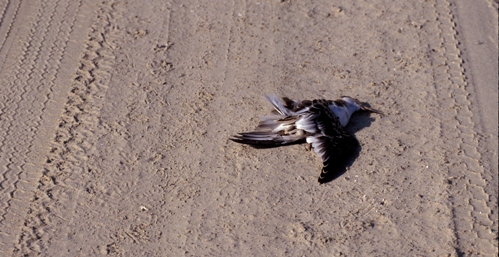
Humans are also a predator here, motived by impulses others than consumption. Humans prey on sand flat wildlife through ignorance, through insouciance. They drive their SUVs over baby Wilson’s plovers, tiny cotton swabs perched on matchstick legs. They spin their wheels through black skimmer eggs, and squash least tern chicks between their treads. Hey, it’s just good-natured fun! Hell, it’s Texas! It’s my God-given (or at least Lone Star-given) right!
Actually, no. There is no “unalienable” right to kill. You can hunt. You can fish. Both are regulated, and there are laws that determine when, where, and how many you can “take.” But the public, ignorant as it is, has no right to slaughter the sand flats because it is too insensate to care. I grew up on these beaches. I have fished, hunted, photographed, birded, bugged, and surfed them for my entire lifetime. I know how idiotic Texans can be on a beach, but killing is not idiotic. It is illegal. It is evil.
My brethren, my fellow Texans, are once again on a rampage. They are spilling onto these sand flats, carving their SUVs through birds, beaches, and babies. They do not care who or what gets hurt. They have their misperceived, Palinesque “rights.”
If you care about these sand flats, if you care about these birds and other wildlife, if you care about a landscape that defines who we are as Galvestonians, then you should care enough to take the actions necessary to stop these fools. Here is what I would do (and am doing). Call, write, or visit the City of Galveston, Texas Parks and Wildlife, US Fish and Wildlife Service, and the National Marine Fisheries Service and demand that they enforce the law (think West Virginia and coal mines). Write your newspapers and bring this to the public’s attention. Mention this issue at your local birding club meeting. But most importantly, get pissed. Get mad. Get involved.
Pennsylvania DCNR Park Management
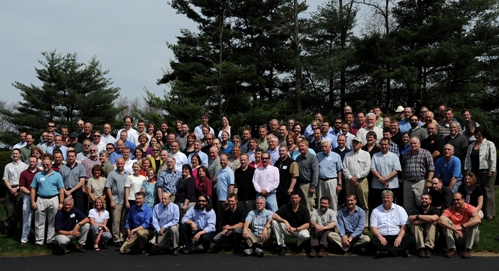
As I previously noted, I spoke yesterday (7 April) to the annual gathering of PA DCNR state park managers and staff in State College. This group photo is from that gathering, one that I copped while the official photographer staged the group. Take a good look at these folks. They manage the best state park system in the nation, according to the national gold medal award they received a few months ago from the American Academy for Park and Recreation Administration in partnership with the National Recreation and Park Association. For their great work they received a budget cut from the PA legislature. Congratulations.
The recent economic blowup has shown precisely what is and what is not sustainable economic development. In my opinion, the first tenant of sustainable development should be to keep people gainfully employed, followed closely by protecting and enhancing people’s quality of life. Remember that curious phrase in the Declaration of Independence (4 July 1776): “life, liberty, and the pursuit of happiness?” Remember that the Declaration stated, unequivocally, that these rights were “unalienable?” In case that slipped by you in that 7th grade American history class, here is the phrase in its entirety:
We hold these Truths to be self-evident, that all Men are created equal, that they are endowed by their Creator with certain unalienable Rights, that among these are Life, Liberty and the pursuit of Happiness.
Apparently this concept appeared earlier in the Virginia Declaration of Indepdendence (12 June 1776), which stated the following:
What all men are by nature equally free and independent, and have certain inherent rights, of which, when they enter into a state of society, they cannot, by any compact, deprive or divest their posterity; namely, the enjoyment of life and liberty, with the means of acquiring and possessing property, and pursuing and obtaining happiness and safety.
Please notice the reference to the inherent right to acquire and possess property in the Virginia version. Franklin and Jefferson thought that they should tone that down somewhat for the U.S. declaration, since slaves where considered property at that time as well as land. In other words (big surprise), in Virginia they declared that men (and they meant men) had the inherent right to the “enjoyment of life and liberty, with the means of acquiring and possessing property….” Virginians declared their inherent right to own slaves, in other words (or, at least, in my words).
Let’s get back to my original reference, to that curious “life, liberty, and the pursuit of happiness.” I understand “life.” I understand “liberty.” But doesn’t “pursuit of happiness” sound a bit queer? Perhaps, but doesn’t “quality of life” sound equally odd? Life and liberty are immutable, black and white. Happiness is soft, squishy, like “quality of life.” But don’t we all know when we are alive, when we are free, and when we are happy? Are the three unalienable rights all that different?
Parks and open spaces have always been part of this “happiness” component. But let’s first consider the other two. Originally the open lands of the U.S. provided natural resources, food, water, and inhabitable space for the growing American population. The overcrowded European landscape is one reason so many immigrants risked the voyage. As American’s began to sprawl, the need to conserve and protect lands for their natural resources, game and wildlife, and water became apparent. Thank you, Teddy Roosevelt and Gifford Pinchot, among others. These public lands, to this day, provide critical protection for resources such as wildlife, timber, gas (such as Marcellus Shale), and water. They give us life.
I would argue that the public lands, as the most perfect expression of the American democracy, also give us liberty. Within a public park, we are all equal. We did not create private game parks such as in Europe, open only to the aristocracy. In the state of Pennsylvania, anyone can enter a state park and enjoy their public lands at no charge. There are free, as in liberty.
These people gathered in the photo above shoulder the responsibility of protecting these public lands for future generations. They also offer the broadest selection of recreational opportunities feasible given budget constraints and carrying capacities of individual parks. Yet they are rarely thanked for their dedication, for their commitment. Like so many public servants, they are seen by many as the complaint desk.
I, for one, thank them for their hard work and sacrifice. Pennsylvania is the birthplace of some of the earliest concepts of parks, public lands, and conservation. Pennsylvania, in my mind, is the cradle of conservation. This is the DCNR heritage, and I believe that the agency and its personnel take their charge seriously.