Category Archives: Fermata

Philadelphia’s Fairmount Park

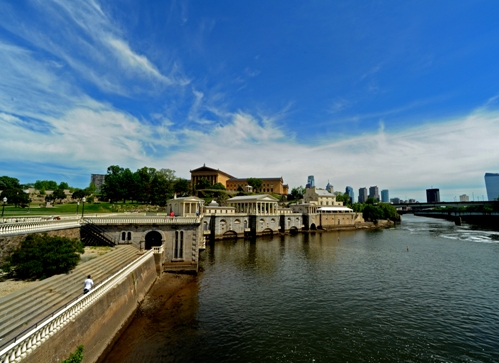
Fairmount Park, Philadelphia Water Works

Political currents steer us all, and at their whim. Since the advent of the Rendell Administration in Pennsylvania Fermata has been working alongside the PA Department of Conservation and Natural Resources in a series of progressive conservation efforts. The initiatives (called CLIs, or Conservation Landscape Initiatives) have matured to a point where they are beginning to influence other states as well the federal government. The CLIs were the brainchild of Michael DiBerardinis, who served as the Secretary of the agency. Secretary DiBernardinis is now Commissioner DiBerardinis of the Philadelphia Parks and Recreation Department. As a native Philadelphian, the Commissioner felt it time to return home from Harrisburg. With a new administration certain (Governor Rendell is at the end of his 2nd term), Commissioner DiBerardinis decided to tackle one more challenge – the reshaping of Fairmount Park, the Philadelphia park system.

Fortunately the Commissioner has asked Fermata to help (i.e., lucky for us). The Commissioner is one of the most progressive  and inspiring conservation and recreation leaders in the country, and we are honored to work for him again. Fermata’s Ted Eubanks has now visited Philadelphia on four occasions, and has come away in awe of the history of Fairmount Park. Even though many Philadelphians tire of hearing about their firsts (America’s first hospital, zoo, art museum, free library), we believe it important to remind our public that Fairmount is America’s first park. Over the centuries the park has grown to include the cultural and scientific centers arrayed along Ben Franklin Parkway, the Wissahickon Valley, the Schuylkill trail, East and West Park, and a mind-bending assortment of facilities, lands, staff, and volunteers. Fairmount is America’s largest urban park, and the system offers more park land per capita than any American city over 1 million population.
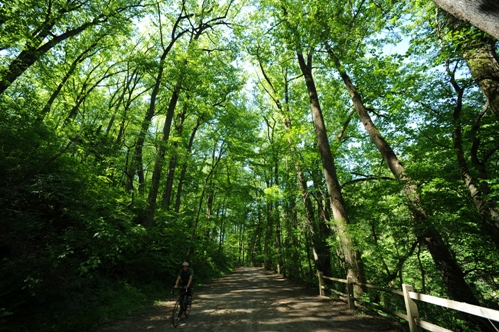
Forbidden Road, Wissahickon Valley

Consider this. Standing in Love Park, you can walk up Ben Franklin Parkway to the Philadelphia Art Museum and the Water Works, connect to the Schuylkill River Trail and hike or bike to where connects with the Wissahickon Trail, continue up the Wissahickon to Forbidden Drive, follow Forbidden Drive to Northwestern Avenue, and for that entire 16 miles never leave park land. Hiking along Forbidden Road in the Wissahickon Valley you would never know that you are within in a stone’s throw of downtown Philadelphia. Fairmount is America’s great urban park, conserved and nurtured by the people of America’s first great city. For more information, go to Fairmount Park under Current Projects.
Food!

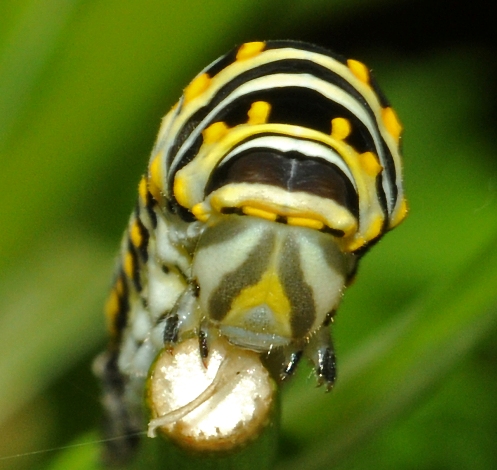
Black swallowtail on parsley

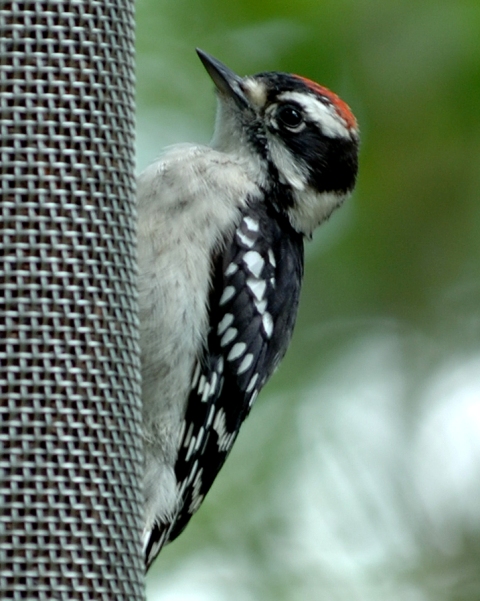
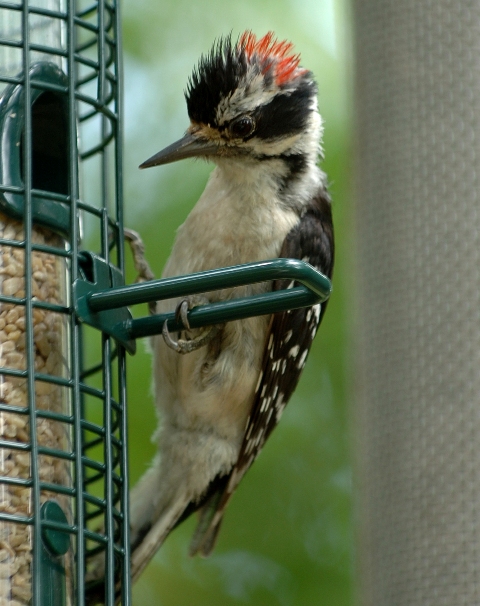
My yard is a feeding frenzy, an orgy of young and old, big and small, eating their ways toward winter. As I walk along my flower beds I hear the constant crunch of caterpillars, ants, pill bugs, and grubs making short work of my crops. The bird feeders are crowded with parents cramming the gaping mouths of young with masticated seeds. Never mind that the young downy is larger than the adult; instinct always wins out over common sense.

Downy woodpecker (adult male)

Doesn’t he know that this young bird is a bottomless pit, an empty hole that can never be filled? No wonder he has brought the family to the McDonalds of the bird world – my feeders. Supersize it.

Downy woodpecker (juvenile) Austin, Texas, 21 May 2010

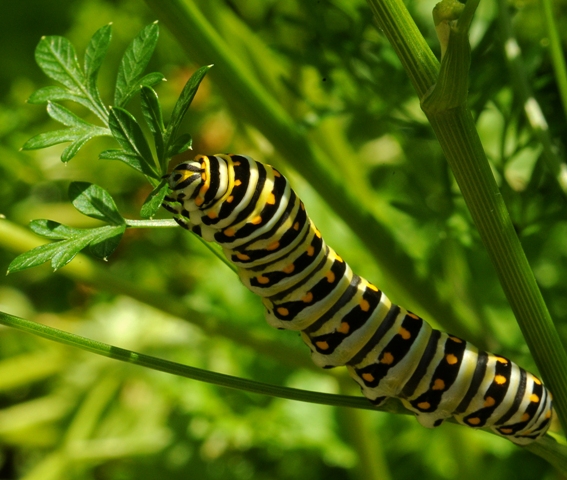
Supersized are these final instar black swallowtails, moments away from tranforming all of my dill and parsley into an ephemeral butterfly. All that work, all that herb, for a few days of ebony bliss.

Black swallowtail

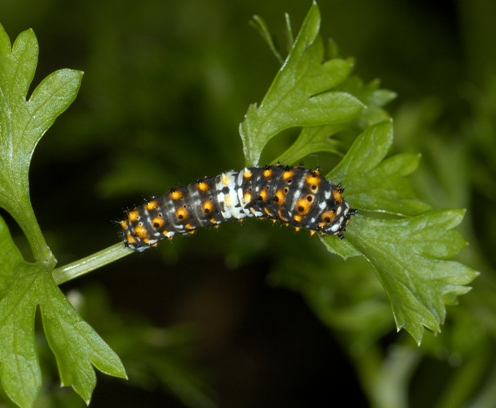
Swallowtails begin as caterpillars that look like bird droppings. They will go through four molts, which represents five distinct instars. The first three are covered with spikes with a bird-drop white ring in the middle. Only in the final two instars do they swell into the sausage-shaped caterpillars that are obvious on your crops.

Black swallowtail (3rd instar), Austin, Texas, 21 May 2010

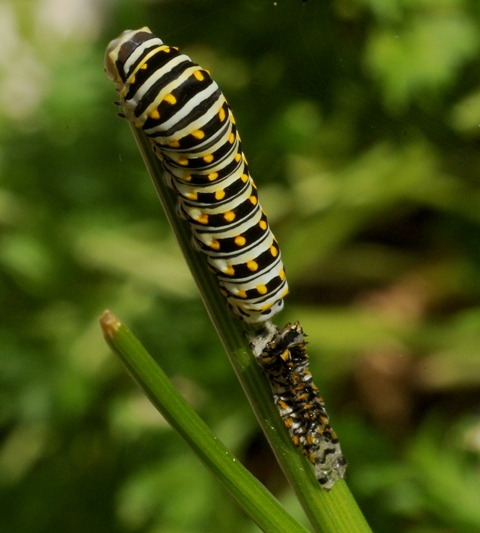
In this next photograph the caterpillar, now a 4th instar, has molted its 3rd instar exoskeleton and is drying in the sun. During this brief period the caterpillar will expand its size with air so that when the exoskeleton dries there will be room inside to grow. After the final instar the caterpillar will defecate one final time, passing not only waste but its entire digestive tract. As an adult the butterfly will nectar but not feed. The gut will not be needed.

Black swallowtail (4th instar) after molting, Austin, Texas, 21 May 2010

Are you interested in low-impact, sustainable recreation? Discover your own yard and its inhabitants. See what might be found in the exotic world of your own community.

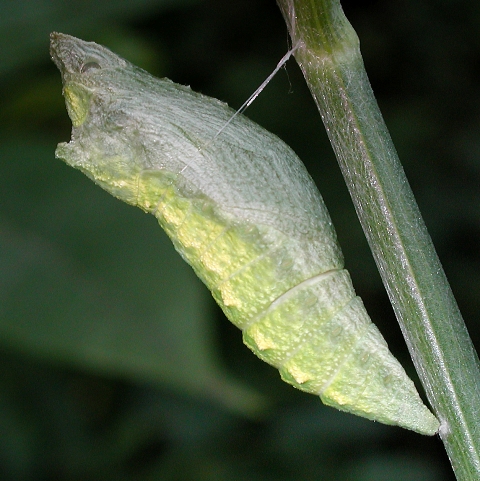
Black swallowtail chrysalis, Lone Star Lakes, VA, 8 Aug 2001

Marcellus Shale in Pittsburgh

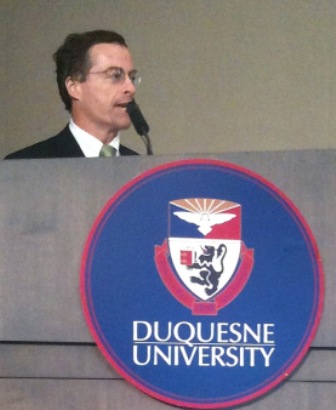
John Quigley, Secretary of DCNR, speaking at PEC Marcellus Shale conference

Yesterday I spoke at the Marcellus Shale conference luncheon at Duquesne in Pittsburgh. The conference is sponsored by the Pennsylvania Environmental Council, and is considering all of the impacts of the Marcellus Shale play here in the east. Marcellus may be one of the largest natural gas reservoirs discovered in the U.S., and there is tremendous interest in bringing that gas to market. Given Pennsylvania’s history with extractive industries, though, the state is being cautious in how it proceeds. I spoke on the conservation history of Pennsylvania, a topic that I title the Cradle of Conservation. I suspect that I will eventually write a book on the subject. My PowerPoint has now been uploaded to the cloud, and is available here.

My next stop is Harrisburg, where I speak to the Pennsylvania Parks and Forests Foundation awards dinner this evening.

Ted
4 May 2010

British Petroleum Debacle in the Gulf

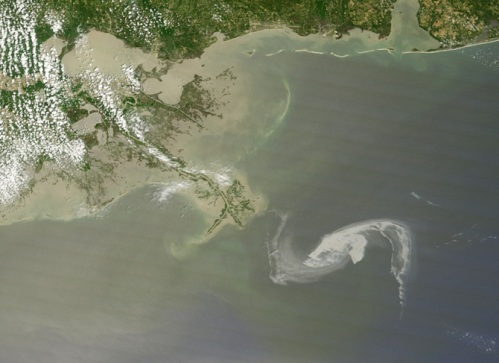
British Petroleum blowout in Gulf of Mexico
The BP blowout in the Gulf is more than a passing interest. I live within five blocks of the Gulf Coast, in Galveston. One wind shift and we are knee deep in black ooze.

This is not new for us on the upper coast. In 2005 the BP refinery in Texas Coast exploded, killing 15 workers. BP received a record $53 million fine for safety violations. BP agreed that costs were a major factor affecting safety measures at the plant.

AP has reported that prior to this most recent event,

BP suggested in a 2009 exploration plan and environmental impact analysis for the well that an accident leading to a giant crude oil spill — and serious damage to beaches, fish and mammals — was unlikely, or virtually impossible.

The plan for the Deepwater Horizon well, filed with the federal Minerals Management Service, said repeatedly that it was “unlikely that an accidental surface or subsurface oil spill would occur from the proposed activities.”

The company conceded a spill would impact beaches, wildlife refuges and wilderness areas, but argued that “due to the distance to shore (48 miles) and the response capabilities that would be implemented, no significant adverse impacts are expected.”

The potential impact on the ecology of the Gulf Coast is catastrophic. The effect on coastal communities is unimaginable. Following in the footsteps of hurricanes Katrina, Rita, and Ike, the Gulf Coast is hardly prepared for another major disaster. Bolivar and Galveston, for example, are still reeling from Hurricane Ike 18 months ago.

As this tragedy unfolds, I will try to keep posted the links that appear to me to be covering the story most accurately. Language is a tricky thing, and slight changes in wording can dramatically alter the meaning of a statement or story.

Here is an example. The press continues to use the word “spill” to characterize this debacle. This is no spill, it is a blowout. The blowout preventer failed, and now there is unchecked oil and gas jetting to the surface of the Gulf from over a mile down. If officials are unable to recap this well, it will continue to flow until the pressure in the reservoir diminishes to a point where the oil and gas cannot no longer escape.

Ted

NASA Imagery
Field and Stream
Audubon’s Frank Gill’s editorial

On the Road (again)

The next few weeks are dominated by travel. There is nothing like spring to entice one outside. This week I am in Scott County, assessing sites for a heritage tourism analysis. We are working with Carolyn Brackett, a Senior Program Associate with the Heritage Tourism Program, National Trust for Historic Preservation. After returning to Texas on Thursday I will be in Galveston, trying to finish dismantling the Houston office.

On Sunday I fly to Pittsburgh, and then spend next week in Pennsylvania. I am speaking at Pennsylvania Environmental Council’s Marcellus Shale conference Monday. I then travel to Harrisburg on Tuesday to attend the Pennsylvania Parks and Forests Foundation’s annual awards dinner that night. PA DCNR parks recently won the gold medal for being the best state park system in the nation, and that night we will all celebrate their success.

I will continue on to Philadelphia the following morning, and I will work the remainder of the week in Fairmount Park. The last time I visited Philadelphia we were hampered by the remainder of a blizzard, and it will be wonderful to see the park facilities exposed.

Finally I will fly to Chicago on Sundayt, and then drive to Valparaiso (Indiana) for a couple of days work on Indiana Beyond the Beach. We are about to unveil a number of new products regarding the BTB Discovery Trail, so stay tuned. I will blog from the road as I travel these next weeks.

Ted Eubanks
26 April 2010