Category Archives: Fermata

Faces of Flight – Space for Place

High Island, Texas

The weather heads salivated for days. Nothing provokes a Pavlovian response in weather geeks more than another storm of the century (How many are we allowed in one century?). I knew Pittsburgh to be in the path, but we glided into town with little trouble. Deplaning I watched the frontal system sweep the runway, and by the time we entered the terminal spitting rain and raging winds shook the building. Scheduled to speak in West Virginia the following day, I sprinted to my rental car and headed west toward the interstate. I made the mistake of following the directions dictated by my iPhone, and soon I left the interstate far behind and slid toward Appalachia on a narrow, serpentine two-laner.

While certainly no hurricane (I love how the weather heads trot out that analogy.), I decided that the rain, wind, darkness, a narrow road, and 60-year-old eyes did not blend well. I bailed early. Reaching I-76 (my route south), I navigated toward Cambridge, Ohio. I am not sure if I had previously heard of Cambridge, but I am certain that I never visited (To be honest, I still don’t know why I ended up in Ohio.). Situated at the intersection of two interstates, I suspected that I could find a hotel and restaurant along the highway. I exited the freeway at Cambridge and entered the American Everywhere.

James Kunstler characterized America as “ever-busy, ever-building, ever-in-motion, ever-throwing-out the old for the new; we have hardly paused to think about what we are so busy building, and what we have thrown away. Meanwhile, the everyday landscape becomes more nightmarish and unmanageable every year. For many, the word development itself has become a dirty word.” Cambridge, I found, is this everyday landscape. The town offered its handshake with Ruby Tuesday, Hampton Inn, McDonalds, and Pizza Hut. All were the same as at home; all were the same as found throughout interstate America. To Kunstler this is nowhere; to me it’s everywhere.

America is new, rootless. Americans share an impoverished sense of place. We have no Mecca, no Angkor Wat, and no Taj Mahal. American natives have special places, but we immigrants see little value in them. Consider the conflict over Bear Butte, South Dakota. To the Lakota this is sacred ground. To Sturgis this is a potential campground and parking spot for Harley riders.

Early conservationists believed that America’s specialness could be found in her landscapes. Theodore Roosevelt said that “There can be nothing in the world more beautiful than the Yosemite, the groves of the giant sequoias and redwoods, the Canyon of the Colorado, the Canyon of the Yellowstone, the Three Tetons; and our people should see to it that they are preserved for their children and their children’s children forever, with their majestic beauty all unmarred.”. For Roosevelt, what America lacked in ancient monuments and edifices it more than gained with her transcendent lands and wildlife.

Americans, however, are now becoming detached from this heritage, with these special places. Roosevelt warned that “the lack of power to take joy in outdoor nature is as real a misfortune as the lack of power to take joy in books.” How many Americans take joy in either? In 2004, a National Endowment for the Arts report titled “Reading at Risk” found only 57 percent of American adults had read a book in 2002. The Outdoor Foundation reports that over half of Americans “take no joy in outdoor nature,” with alarming numbers of children divorced from the outdoors.

Now, slipping into Cambridge, I confront the America devised by its marketeers. I see the America invented by global hucksters, their goods relentlessly hawked on the ubiquitous television. The McDonalds on the screen is the McDonalds in Cambridge. The Wal-Mart on television is the Wal-Mart in Cambridge. The streets signs, billboards, traffic lights, and facades are no more real in Cambridge than on the tube. This version of America, known by all, is fakery unleashed and unlimited. I can’t decide if I am in the Matrix or the Truman Show.

As a child I would visit my grandparents in Paris (Texas) several times a year. In that pre-interstate age (President Eisenhower, who initiated the interstate system, did not begin his presidency until 1953.), the roads invariably wended from downtown to downtown. My sister and I knew every hamburger joint and rest stop between Bryan and Paris. Even today I remember the sweet-and-sour lusciousness of the limeade in Sulphur Springs. Each town along our route had an identity, a character.

Now, your McDonalds is my McDonalds, your Wal-Mart is my Wal-Mart. Why leave home if all that is offered away is the same as in your neighborhood? Forget the family that once owned and worked in that Sulphur Springs hamburger and limeade joint, or the snow cone cart by the railroad track that my grandfather would take us by after work. What is more important to Everywhere America is that (1) everywhere is the same, and (2) everywhere is cheap.

One hotel is easily replaced by another (Hampton by Holiday Inn Express). One restaurant is easily substituted for another (Ruby Tuesday by Chiles). But what about that for which there are no substitutes? Would you replace Gettysburg with any Civil War site? What about substituting a pileated for the ivory-billed woodpecker, or a mourning dove for the passenger pigeon, or a penguin for the great auk? In a world of cheap throwaways and easy replacements, that which cannot be replaced is at risk.

Returning to my factory hotel I jotted a note on Facebook about Cambridge, a brief snippet asking “where the hell am I?” The responses came immediately. One friend wrote “heard of it. Dangerously close to my old stomping grounds and soon to be new stomping grounds. And yes, there’s really not much there!!” My heart sank (not really; I stopped for a meal and a bed). Then another friend sent the following: “You are near an excellent birding location! It’s called “the Wilds.” It’s a reclaimed strip mining area… The facility also has yurts for overnight guests. Very cool place and staff.” Soon another posted that “that area is full of special places…the Wilds being number one.” Humm, there seems to be a there there.

But how would you know if you bumped into Cambridge from the interstate? Like America, Cambridge is hidden by a shiny plastic wrapper. Only when you peel the layers back do you find the meat on the bones, the Hocking Hills, the Salt Fork State Park, and the Wilds. The American marketing machine sells gloss and I am interested in gristle.

How can we save that which does not exist for most Americans? Federal programs such as the National Heritage Areas and America’s Byways are selective and only touch on a few of these special places. Getting people into the outdoors is only a small part of the challenge. First, they need to know where to find the outdoors. Second, once there they need help in connecting to the land, its recreations, and its stories. Modern television marketing is delivered turn-key, without any requirement that you think. In the outdoors, the experiences are earned rather than gratis.

Finally, our special places need space. The American soul (as tangibly embodied in these places) is being squeezed from all sides, with what makes the American experience special being pushed aside for a marketeer’s version of the American story. American places need space in the American mind and in the American landscape. These are the American touchstones, special places with names and physical locations where we return to remind us of who we are, what we have accomplished, and how to navigate forward based on our past experiences.
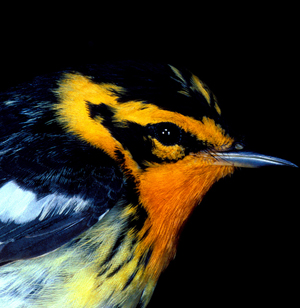
Blackburnian Warbler

Isn’t this a critical aspect and appeal of birding? Each spring I return to the Texas coast to see the same birds that pass through the same special places such as High Island. With each day new migrants appear, northern parula followed by rose-breasted grosbeak followed by blackburnian warbler followed by yellow-billed cuckoo followed by least flycatcher. What could be more reassuring than the annual reappearance of birds that we exert absolutely no control over? As long as we protect their places, their cycle will continue. As long as we protect their places, our children and grandchildren will find the same inspiration and joy in this spring ritual that I have for the past four decades.

In the early 1990s I begin developing the first birding trail with Texas Parks and Wildlife. I remember being criticized by a group from Colorado that assured me that “real” birders did not need my birding trails. Perhaps “real” birders can find these special places, but the vast majority of the rest of us can’t. With initiatives such as birding trails, IBAs, and eBird places we are bringing America’s special birding places to the attention of the public and the officials guided by their sentiments. Birding trails are a celebration of birding places, those parks, refuges, and sanctuaries where we return to reassure ourselves that the world is still spinning and that the birds are still migrating.

America is adrift, stumbling forward with a road map drawn by shock-jocks and gas bags. When lost we tune in our favorite bloviator and ask for directions. Yet there is a real behind the unreal, a wonderful store filled with goodies behind the facade. If you want to know the American story, you must experience the American places. If these places are to continue to comfort, inform, enlighten, entertain, inspire, enliven, guide, and reassure us, then they must be given ample space in the American psyche. America, now more than ever, needs space for place.

Ted Lee Eubanks
4 Nov 2010
Faces of Flight – Scream

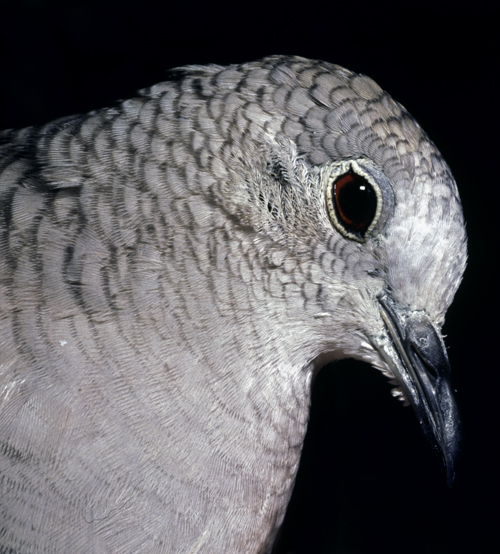
Inca Dove
Galveston, 6 a.m.

The doves are power cooing the windows out of their frames. How did doves and lost love become synonymous? The only sadness I feel is for lost sleep. The main chorus consists of white-winged and Eurasian collared-doves. Both are immigrants. White-wings were limited in my childhood to a few scattered through oaks around the court house. Collared doves were unknown. Now both blanket the city, and I often see droves lined shoulder-to-shoulder, wingtip-to-wingtip, along the telephone wires. This morning the crowds have apparently chosen my yard for their caroling. Cucurrucucú, paloma, ya no le llores.

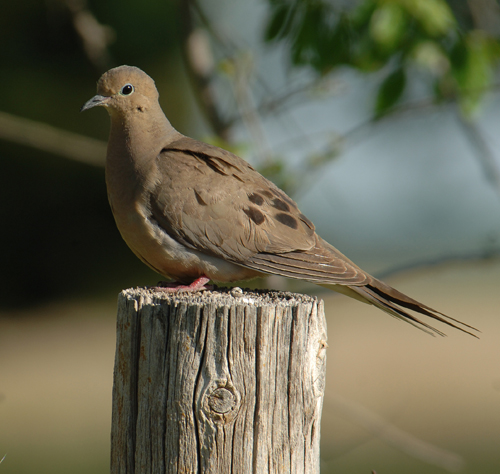
Within this cooing cacophony I detect the slight, almost apologetically soft flutes of the Inca dove. The Inca is also an immigrant, arriving on the island in the 1950s. The Inca survives around the edges, avoiding being bounced by the brutes. I rarely see more than a few together, quietly sifting for seeds through the scalped grass at the Ursuline Convent. The only loser to the recent immigrants is the native mourning dove. Mourning doves have been forced from many Texas urban centers out to the hinterlands.

These changes have taken place over the brevity of one lifetime – mine. I wonder how many people noticed. Perhaps the incessant noise of urban life, the auditory trash, inures us to the coming and going of nature. Our senses are cauterized, and that which we should miss never exists in the first place. Who can hear the pleadings of an amorous dove through ear buds?

Recently I drove to Rockport for a lunch meeting, and once finished curved north along the Texas Coastal Bend before returning home. Time spent along the Texas coast will leave you with two distinct impressions. First, the Texas coast is chock-a-block with birds, particularly doves. Nowhere can they be escaped. Second, also inescapable is the debris and detritus of humanity. Only in protected areas (refuges, private ranches, sanctuaries) and in a few caring towns can you avoid the abandoned double wides, scoured industrial sites, belching refineries and factories, and the tattered, sclerotic communities that define the coast. Yes, we share some of our trashiness with others around the Gulf of Mexico. The truth is inescapable – we are awash in visual and auditory trash. Humans and garbage walk hand in hand along this beach.

I confess; I am an Aldo Leopold aficionado. In college I found his writing tiring, even depressing. Now, at age 60, I hang on his every word. Here is Aldo’s take on the human existence:

One of the penalties of an ecological education is that one lives alone in a world of wounds. Much of the damage inflicted on land is quite invisible to laymen. An ecologist must either harden his shell and make believe that the consequences of science are none of his business, or he must be the doctor who sees the marks of death in a community that believes itself well and does not want to be told otherwise.

Mourning Dove
As birders, as nature watchers, we are, at least at a rudimentary level, ecologists. Perhaps our ecological interests are bottle necked (identifying birds), but I cannot imagine a sentient birder who cannot see both bush and bird. Our experiences with birds and nature should offer us a unique perspective to share with our fellow citizens currently walled off from nature.

Few of us care enough to make the effort. Birding is a game, a pastime through which we relax and escape. We are fortunate, for numbers of birds readily adapt to highly altered landscapes and our disinterest. We look for crows at dumps (aka landfills), waterfowl in settling ponds, pelagics from rip-rap jetties, and shorebirds on tidal flats created by these jetties. Most of us bird in damaged landscapes; few us of have ready access to “wilderness.”

But a park and a trash heap are different. A park is modified, but in a way that most of us find pleasing. Trash is an affront to the senses, yet people, like birds, seem to adapt to a degraded circumstance. Why?

I know the standard arguments – ignorance and poverty. But I have traveled to places where the poor did not live in squalor, where people took pride in the very little that they had scraped together in this life. Along the Texas coast, between these spellbinding protected lands, I see little pride. What I see are heaps of trash.

My family fled to Texas from hard-scrabble Mississippi immediately following the Civil War. I love my state as much as anyone, and from that attachment comes my anger and disgust. Perhaps we in conservation have spent so much time fighting for protected places that we overlooked what surrounds them. Shouldn’t conservation bleed into communities as well?

Nabokov said:

I prefer to accept only one type of power: the power of art over trash, the triumph of magic over the brute.

I hope that no one is born a brute, but I do see many (or evidence of many) who have forsaken art and beauty. Enter birding. Birds, to me, are art more than biology. If we hope to touch the insensate masses, we must use poetry and song as much as prose and science. This is the reason that so many Americans still struggle with global climate change, and, in many cases, are aggressive deniers. With all of our proof, all of our science, we have failed to give the common man the slightest reason to care.

Birds see a world at risk where our crude actions, our trash, spoils even the most rudimentary existence. But birds cannot speak for themselves. We must be their voice to testify. It is not enough to only see, to only watch.

Scream.

Ted Lee Eubanks

15 October 2010

Faces of Flight – The Mulberry Birds

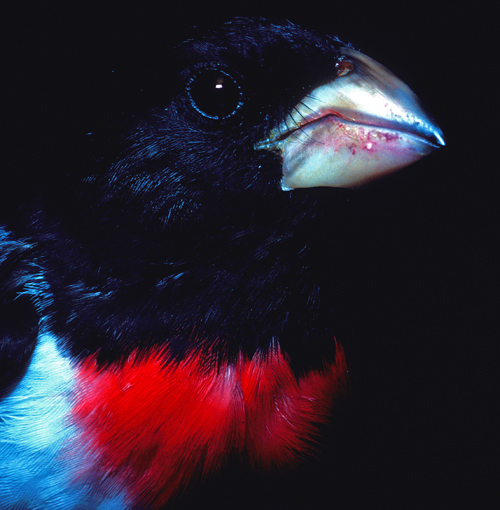
Rose-breasted Grosbeak
Splat.

Purple juice spreads over my right shirt sleeve, gradually coalescing into a shape vaguely reminiscent of the Lesser Antilles. I peer upward, through the leaves, and see a rose-breasted grosbeak, its beak and breast equally tinted with a wine hue. The grosbeak gulps fruit with an audible appetite, each mulberry carefully manipulated in that outsized beak into its proper position before being inhaled into the bird’s gullet. Mistakes and choices are made, and a few of the berries slip from its grasp and fall to the ground or onto my shoulder.

Fingering my binoculars, other birds begin to appear within my focus. Buntings, orioles, tanagers, and grosbeaks are packed into this one tree, each enmeshed in a mulberry feeding frenzy. These are the mulberry birds, a cadre of audaciously decorated birds that are lured into my sight by the gravitational pull of one fruit – the mulberry.

In this instance, my mulberry tree is one of a row planted many years ago by Louis Smith in what became Houston Audubon’s Boy Scout Woods Bird Sanctuary in High Island, Texas. One fall Louis harvested a number of substantial branches from mulberries in the area, and then planted sections of the limbs along the pathway into the woods. The following spring these mulberries came to life, with their futures only briefly threatened when a couple of neighborhood kids decided to make their mark by uprooting the fledgling trees. I helped Louis replant the starts, and they seemed to take little notice of being yanked from the ground. I have often wondered how many individual birds have been nourished by Louis’s trees, and how many birders have been stained by their fruit.

The red mulberry (Morus rubra) is native to the eastern United States, spreading along the Texas coast as far south as the Coastal Bend. Birds (particularly migrants) sow the seeds widely through their droppings, and mulberries can be found sprouting in what would seem to be the most inhospitable locations. No matter, though. Come spring the fruit are guaranteed to attract a rich array of mulberry birds, no matter how bizarre the tree’s location might be.

The white mulberry (Morus alba) is a close cousin of the red, brought from Asia to America for silkworm culture in early colonial times. This species has naturalized and hybridized with the native red mulberry. In fact, the white mulberry is considered to be an invasive pest over much of its range. White mulberry is an aggressive pioneer, invading disturbed areas such as abandoned farm fields, highway right-of-ways, and undeveloped urban open spaces.

More ominously, the white mulberry threatens the viability of the red through genetic pollution (undesirable gene flow into wild populations). There are a number of white mulberry cultivars, including those that weep and those without fruit. To be honest, I have as much use for a fruitless mulberry as I do for a heatless jalapeño. The mulberry birds are oblivious to my reservations, and attack the fruits of both with equal zeal.

White mulberry leaves are the favored food for Bombyx mori (silkworm of the mulberry tree), the domesticated silkmoth whose cocoon is the source of silk. Chinese records indicate that the silk moth has been domesticated since 2700 B.C., and the species no longer exists in the wild. The domestic silk moth is now completely dependent on man for its survival and reproduction, and may be the most fundamentally domesticated animal in the world. How ironic that the fruit of the white mulberry is consumed by the wildest of creatures (migrant birds), while the leaves feed the most neutered.

The threat of genetic pollution is hardly limited to mulberries. The native wolf of the Gulf coast, the red wolf, has been on the receiving end of habitat loss and predator control since colonial times, and the remaining few freely interbreed with the expanding coyote. As a result fewer than 300 “pure” red wolves remain in existence.

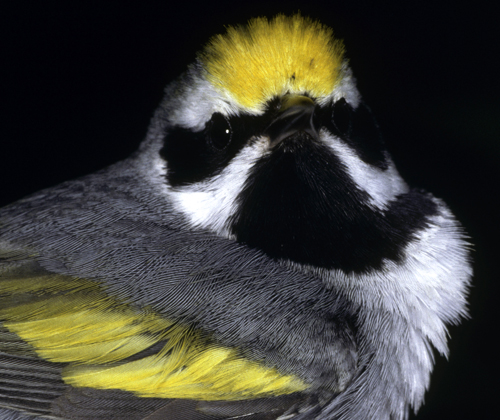
Golden-winged Warbler

Golden-winged and blue-winged warblers also interbreed, with the hybrids even given their own common names (the dominant Brewster’s, and the recessive Lawrence’s). The golden-winged favors early-succession habitats, such as abandoned farmlands. As disturbed lands reforest, the golden-winged is displaced. In addition, these anthropogenic (man-caused) habitats allow the blue-winged to expand into the golden-winged range. The blue-winged then freely hybridizes with the golden-winged, often replacing the golden-winged within fifty years of its initial arrival. There are concerns that the golden-winged warbler may well disappear as a viable species in the future.

Yet my concerns about man’s tinkering with nature are momentarily shelved as I relish the sight of this grosbeak working his way along the branches like a shopper breezing through the produce section. Each fruit is individually inspected and assessed according to criteria known only to grosbeaks. Is this fruit ripe? Is this fruit sweet? Is this fruit blemished? I also wonder if each individual grosbeak has a particularly taste in mulberries, or does the need for nourishment after a nonstop flight over the Gulf of Mexico trump taste. I can only imagine what drives this grosbeak to choose one mulberry (tree and fruit) over the others, but in the end choices are made. My grosbeak is particular.

My grosbeak is also a short timer, wasting little time with this meal before continuing away from High Island to the forests of the eastern U.S. and Canada. This mulberry tree, here by plan, annually attracts birds that ultimately span thousands of miles of breeding and wintering range. For one moment, one brief instance, this tree is festooned with birds brought together by fruit rather than geography. And, for this same moment, I am brought together with the mulberry birds, also by plan.

Ted Eubanks
17 October 2010

Faces of Flight – Bird by Bird

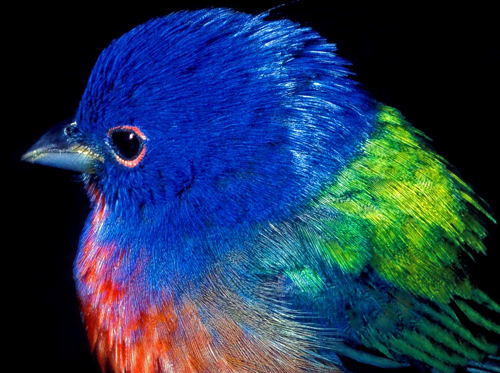
Painted Bunting
How does one come to a life with birds?

Are there sentient peoples that have walked this planet and not known them? Not the Inuit, with streams of murres, guillemots, and puffins cascading across their arctic landscape. Certainly not the ancient Egyptians, who balanced their deification of the cat with heiroglyphical cranes, geese, and falcons. There are prehistoric stone sculptures of echidnas from New Guinea, quetzals from the ruins at Chichen Itza, and sea eagles atop Alaskan totems. To breathe, to open one’s eyes and ears each morning, is to know birds.

I came to birds with, but not through, my parents. My father hunted birds (he would later abandon his shotgun for binoculars), and I often accompanied him on late summer dove hunts in rural central Texas. I suspect that my life with birds began at a much earlier age, though, and stemmed from a fascination with birds as accessible expressions of life.

I point to my mother’s archives as evidence. She neatly squirreled away most of my kindergarten drawings, elementary grade report cards, baseball team photos, and prom invitations, and passed these family heirlooms my way late in life. Rummaging through these “treasures” I found a number of my construction paper drawings in which birds are clearly and recognizably rendered. In one there is an obvious northern cardinal, tinted with a fiery color only found in a Crayola box. Given my age at that time (four or five) I can only guess that my life with birds began as childhood curiosity, one that eventually flowered into a passion that would eventually transcend science, recreation, or reason.

At the University of Houston I majored in journalism. Although I matriculated high school in the late 1960s, Woodward and Bernstein were only peripheral or distant inspirations. My heroes were Roger Tory Peterson, Elliot Porter, and Louis Agassiz Fuertes. Journalism (particularly photojournalism) swelled my interest in photography both as art and as information. With birds as a subject, I could now explore ways in which the photographed bird might advance beyond “documentation.” For a birder, the photographed bird is proof that it existed. With proof a birder “scores.” I wanted to do more with my photography, to show birds as I perceived them metaphysically. I wanted to show birds as individuals, not as species or specimens. I wanted to capture life on film.

My studies exposed me to more than photography’s immediate possibilities; I also learned of its past. From Henri Cartier-Bresson’s The Galveston That Was to George Hurrell’s Jean Harlow and Jane Russell, I began to grasp that the photographic process was far more complex and demanding than “point-and-shoot.” I learned of photography’s discipline and rigor, of the basic principles of composition, of the power of the well-placed highlight. I studied Cartier-Bresson’s talent for blending into the background, the street, enabling him to closely approach his subjects and capture what he described as “the instant sketch” with only a rangefinder Leica camera and a 50 mm lens. For a time I practiced by photographing birds only in black-and-white, subordinating the seductive power of their dramatic colors to the subtle art of shadow and light.

My early results were desultory, photos taken as through another’s camera. I photographed hoping to recreate pictures I had seen before. With time, though, I developed a perspective, an eye. My wife, Virginia, helped me understand the concepts of expression and impression and the photographer’s obligation to allow each picture to live up to its emotional (not just documentary) potential. Through her I began to understand that the lens has the power to reshape and redefine reality, to peel away artifice and allow the emotional essence of each subject to show through the clutter and disorder that surrounds them.

With Faces of Flight I focused the eye of the camera on one essential truth – the universal appeal of birds. These are intended as glamour shots, intimate portraits that display each individual bird in the most intricate detail, each feather precisely mapped. Each individual portrait stands alone, evidence that this particular bird and I shared a precious moment and space on this planet. All were captured in and released back to their native habitats without harm. The photographs only record a brief second in time, an “instant sketch,” and reflect only a short interlude in what I hope were otherwise long and fecund lives.

Only late in life, though, have I developed an additional understanding of these birds and their photographs. I began as a birder, evolved to being a naturalist, and only now, with six decades under my belt (and the scars to prove it), am I trying to see beyond the evident and the puerile. Through a life with birds I have come to a better understanding of my life with my fellow man. My essays are a pilgrimage, a solemn journey to a distant corner of the psyche where I might glance back at who I am.

Pablo Neruda, in “The Poet Says Good-Bye to the Birds,” wrote of himself as

…A people’s poet, provincial and birder/ I’ve wandered the world in search of life/bird by bird I’ve come to know the earth…

Picture by picture, essay by essay, I have come to know Neruda’s earth as well.

Ted Eubanks
18 Oct 2010

For those interested in seeing the exhibit, I have load the images as well as the interpretive panels and poster we designed here for your enjoyment. The original is now in the hands of Karla Klay of Artist Boat, and I hope that she will use the exhibit to help raise funds for her wonderful organization.

Isolated in Iceland (Thinking About Partisan Politics and the American Conservation Movement)

TLE in RKA
I lie between the dead and the living, my eyes barely cracked, my skin licked by a million tiny molecules of dank, sour air. The neighbor’s blue tick is baying at an imaginary foe, and a chainsaw is slicing the remaining silence to remind me that no one sleeps in on Sunday. As I struggle to the coffee shop my path is blocked by police escorting the dozen UCLA charter buses back to the airport and the land of milk and honey sans offshore drilling. Edward Abbey said that “there is science, logic, reason; there is thought verified by experience. And then there is California.”

Skimming Huffpost on my IPad, I notice the story that Delaware Republican Senate candidate Christine O’Donnell has called evolution “a myth” and backed up her claim with the question: if evolution is real, “why aren’t monkeys still evolving into humans?” While isolated in Iceland last week [a grand place to get away; nothing is distracting in Reykjavik], away from the yapping heads, I thought about how partisanship in the U.S., while hardly new, has once again returned to its roots – base ignorance. Nothing motivates voters more than blind hate and mindless fury. I cannot imagine people more blind and mindless than those moved to passion at this moment like O’Donnell.

I have yet to hear a single word from the Tea Party or their kind that resonates with me. To be honest, I cannot imagine why anyone would want to expose such silliness in public. For the Western world the Age of Enlightenment centered on the 18th Century. What is forgotten is that the time preceding the Enlightenment, the Dark Ages, was a self-imposed devolution and backwardness. The Roman and Greek classical ages were temporarily lost not through a force of nature but through the force of human ignorance and religious myopia and corruption. The classics were restored to the West through the benevolence and enlightenment of Islam. I wonder who has our back now (forget Islam, by the way).

A multi-party system of government gives rise to partisanship, a natural outcome of competing ideologies vying for power. But what happens when the parties share a basic ideology? Rather than competing over grand ideas, the parties must battle over minutia. Grand philosophical debate is reduced to petty partisanship and ad hominum attacks. Welcome to our time, the age of microscopic people espousing nano ideas. Change in our age is not about transformation; change in our age is no more meaningful than a change of clothes or sheets.

Conservation has become distinctly partisan as well. Most environmentalists like me are liberal Democrats. Republicans oppose us not because of our ideas but because of our ideology. We embed conservation into a liberal social agenda, and support the party (the Democrats) who are more aligned with liberalism as a whole.

The result is that the Democratic Party presumes that our support will be freely given rather than earned. The partisan alignment of the environmental movement guarantees that the Democrats will ignore us while the Republicans will oppose us. We have convinced ourselves that the Democrat’s passive acknowledgement of environmental issues is better than outright Republican opposition. As a result Democrats are rarely blamed and Republicans rarely credited.

Home in Iceland
I offer this as background to the topic of the moment – the British Petroleum blowout in the Gulf of Mexico. Administrations are judged by how they respond to acute challenges. Successes are celebrated for all ages; failures are never forgotten. America spent two years in the lead up to WW II, but Pearl Harbor is all that is remembered of the early rounds. The Bush administration will forever be haunted by Katrina, and Carter by Iran. The BP fiasco will be seen as President Obama’s day of reckoning, and, to date, I have found him lacking. I suspect that history will as well.

The Deepwater Horizon gusher is an act of man and therefore unlike Katrina, a natural phenomemon or act of God. The federal government had oversight responsibilities of the well from the outset. In this both administrations failed. The MMS cozied up to the industry it regulated in both the Bush and Obama years, and the USFWS permitted the well without an EIS during the Obama administration. Unlike Katrina, the Deepwater Horizon could have been prevented, and in this both administrations were negligent. With that said, we supported Obama because he promised change, not continuation of the disastrous policies and practices of the past. Blaming Bush for BP is as meaningless as blaming Clinton for 9/11. All Americans want to know is who’s on watch.

Where Katrina and BP are alike is in the political responses to the disasters. Simply go back and review press releases from both administrations during the early days of these events. I understand the fog of war, but why are the estimates of negative impacts always low balled? Why do administrations, no matter the party, always grossly understate the obvious knowing full well that the truth will eventually out? The Bush administration estimated that the war in Iraq would cost $50 billion to $60 billion; now the total cost is in the trillions. President Bush praised FEMA in the early aftermath of Katrina (“Brownie, you’re doing a heck of a job”), and the final estimates of oil gushing into the Gulf exceeded early Obama administration numbers by orders of magnitude. How should we, the public, respond to such obvious errors or obfuscations? Oops?

Exactly what has the Obama administration accomplished for the environment that should earn our unquestioning support? Despite a clear majority in Congress, the administration failed to advance cap-and-trade. The America’s Great Outdoors initiative is palliative care (like the Last Child in the Woods campaign), long on meetings and talk but short on substantive change. As Frank Rich said during the early days of the BP gusher,

Obama was elected as a progressive antidote to this discredited brand of governance. Of all the president’s stated goals, none may be more sweeping than his desire to prove that government is not always a hapless and intrusive bureaucratic assault on taxpayers’ patience and pocketbooks, but a potential force for good.

I still believe in government as a potential force for good. I still believe that government of the people, by the people, for the people, shall not perish from the earth. But I also believe, as did Jefferson, that “all tyranny needs to gain a foothold is for people of good conscience to remain silent.”

Early this summer I wrote an article about the environmental movement’s abdication of advocacy. An aspect of this surrender is the partisan alignment of the movement today. Advocacy should be focused on the issues and the cause, not on any particular party or power. For example, Martin Luther King found it necessary to split with President Johnson over the war in Viet Nam in his Beyond Viet Nam speech. This critical shift, while consistent with his cause, led to him to be ostricized by many who had previously supported him. President Theodore Roosevelt battled with his own Republican party over his progressive agenda, particularly conservation and public lands. No matter how vilified or disputed, they remained true to their beliefs and the causes.

The Gulf gusher has been a moment in time that begged for clear, unambiguous leadership and action. When Harry Truman faced a railroad strike that would have crippled the country, he responded by threatening to draft all railroad workers into the Army. Theodore Roosevelt used John Lacey’s new Antiquities Act to circumvent a recalcitrant congress and protect millions of acres of America’s heritage. Franklin Roosevelt closed the banks for a “bank holiday” to stop the hemorrhage that threatened to bleed the country even deeper into the Great Depression.

The BP disaster has been Barrack Obama’s defining test, that one event in time when a presidency is made or broken. Only at these critical moments can a president step outside of his or her political skin and lead the nation as an individual, a fellow American. The country forgave Roosevelt’s being caught off guard at Pearl Harbor because he and the nation he led ultimately won the war. Roosevelt honed in on the prize (victory) and swept away the conventions and structures of the past that kept him from that goal. In the Gulf this president has continued with the shopworn policies and agencies of the past, and has offered little in the way of a grand idea for the Gulf restoration beyond platitudes and promises.

Conservation and the environmental movement (not necessarily the same) should embrace a return to the nonpartisan advocacy of the past. Let me be clear – there are two forms of nonpartisanship. The first is to avoid all forms of advocacy, as seen with groups such as the Nature Conservancy. The polar opposite is an advocacy that believes that all should be held accountable, and that the basic tenants and beliefs of conservation must transcend (rather than ignore) the politics of the day. I care little for the former, but the latter is the advocacy that I embrace and promote.

Let’s return to the Gulf. Here the Obama administration has done little more than promulgate the mistakes and inefficiencies of the agencies and allies that he inherited. Where is the change promised just two years ago? Where is the bold, daring leadership that challenges the country to rise to this occasion, to be its best? The Gulf has been an America colony since the end of the Civil War. Wealth is extracted, with little returned. Isn’t the restoration of the Gulf and its people worthy of this president’s interest and investment?

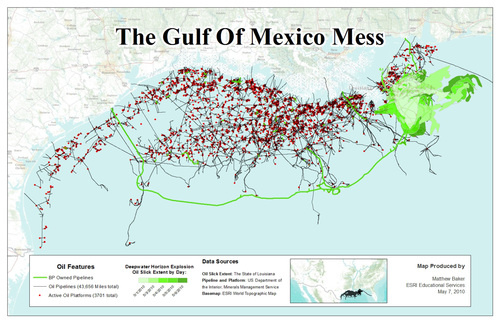
Here is where I would begin. No one disputes that a lot of oil lies untapped under the rocky floors of the Atlantic and Pacific oceans off the U.S. coasts. Yet drilling in these areas has been banned by Congress since 1982. Recently six U.S. senators from the states along the West Coast including Barbara Boxer and Dianne Feinstein jointly introduced legislation to ban all future drilling along the Pacific shoreline. Notice that drilling rigs in the Gulf stop at the Florida Panhandle. Drilling is banned offshore of Florida as well. Why? Why are Alabama, Mississippi, Louisiana, and Texas, along with Alaska, bearing the weight of coastal oil and gas production and refining in the U.S.? And if the Gulf is being sacrificed so that others in the U.S. can drive in their SUVs to their oil-free beaches or ship their crops to foreign markets, shouldn’t the impacts to the Gulf be mitigated for with revenues from these economic activities? Shouldn’t the federal government be investing these revenues back into the Gulf states to build local capacity, expertise, and the research necessary to respond to future spills and future dead zones? Shouldn’t national environmental organizations be aiding local groups and institutions in developing the financial and human resources that would aid this capacity building, rather than sucking even more funding from the Gulf to New York and Washington?

Gulf of Mexico Oil Production

To date reinvestment has not been the trend. Washington-based Defenders of Wildlife has received a $216,625 noncompetitive contract from the U.S. Fish and Wildlife Service for a seabird survey in the Gulf. Manomet, based in Plymouth MA, has received a similar grant to survey shorebirds. Bird cleaning funds have gone to three out-of-area firms. Local universities have been unused, and volunteers have been kept on the sidelines. The issue is not whether or not Defenders and Manomet are well-meaning, worthwhile organizations (they are). My concern is how Gulf environmental interests, as limited as they are, have been effectively locked out by those who should have their best interests at heart.

Did the USFWS believe that Defenders is better qualified to count seabirds than Van Remsen’s LSU, Frank Moore’s Southern Mississippi, Texas A&M, or the Gulf Coast Bird Observatory? Is Manomet more familiar with the shorebirds and their habitats along the Gulf than local birders and scientists that have been surveying shorebirds here for decades? Why aren’t the national environmental organizations insisting on local involvement in the NRDA and environmental assessments, or are they too busy trying to snatch their own slice of the pie?

For those along the Gulf, the refrain is familiar. Funds dedicated to those with the least often end up in the hands of those with the most. For example, five years after the passage of the Gulf Opportunity Zone Act of 2005, more of the tax-free benefits from the Katrina disaster have gone to the Louisiana’s powerful oil industry than to development in hard-hit areas. According to Newsweek,

New Orleans has so far received a total of $55 million in bonds shared between eight projects—or less than 1 percent of the more than $5.9 billion issued statewide. None of the bonds issued for New Orleans projects went to development in hard-hit and still-struggling areas like the Lower Ninth Ward.
Instead, the federal largesse has been poured into oil companies operating far from New Orleans. Since Congress’s unanimous approval of the GO Zone Act, Louisiana officials have issued nearly $1.7 billion in tax-free bonds—about one third of the total issued—for projects that contribute to the production of oil.

I blame the Democrats for continuing with the bankrupt policies and strategies of the past and their continued reliance on organizations and institutions that haven’t conjured a new idea since the 1970s. I blame the Republicans for equating environmentalism with socialism (although I admit that both have relied on strong central government and coercion rather than consent), and for their mindless opposition to our issues no matter the stakes. I especially blame rational members of both parties for not stepping outside of party ideology and allowing themselves to intelligently consider the conservation challenges of our time. As Huey Long said,

The only difference I ever found between the Democratic leadership and the Republican leadership is that one of them is skinning you from the ankle up and the other, from the neck down.

Finally, I blame many in the conservation movement for divesting themselves of an honorably passionate past in the quest for political aggrandizement and financial reward. The Gulf gusher can still serve as a catalyst for change within the conservation and environmental communities. Good can be salvaged even from the wreckage of the Gulf. As I said earlier, there is nothing that I find agreeable in the Tea Party, with one significant exception. At least the Tea Partiers know when to be angry. They are often furious at the wrong people about the wrong issues, but at least they show up. Anger is a potent catalyst, and the time has passed for us to kindle that fire.

[Let me add a comment about the Tea Party. The degree to which the Tea Party is viewed favorably is a measure of how disenfranchised people feel at this moment. The fact that much of the economic and social malaise can be dated to the Bush administration is irrelevant. We elected Obama as a force for change, not to enforce a status quo. The Democrats will be spanked in November, and we will see if this president learns his lessons and salvages his legacy in the last two years of his first term. At this moment, he has only himself and his fellow Democrats to blame.]

We should begin by stripping ourselves of rote partisanship and start embracing an advocacy that towers above politics. Political leaders are not preordained to failure or success. Change is always possible. The advocate’s responsibility is to point out failures, no matter one’s political affiliation, and to suggest measures that may succeed. Spare us the platitudes. With measurable, tangible results will come our support, and not before.

The Gulf would be a perfect place to begin.

Ted Eubanks
26 September 2010