
All posts by tedleeeubanks

Okinawa – Tedako, Child of the Sun

Cassady at Haneda

Jet lag is the one aspect of international travel that, at least initially, erodes the pleasure of the visit. At this moment it is 4 am in Naha, and I am sitting here, bright eyed, pecking at the keyboard. We have a full day ahead of us, and I will probably fade by early afternoon. With luck I will begin to adjust later today or tomorrow.

We departed Tokyo yesterday morning after an all-too-brief respite. As we crossed Tokyo Bay on our way to Haneda (Tokyo’s domestic airport) we noticed dozens of helicopters hovering over the entrance to one of the ports. A small ship with “Research” emblazoned on its side seemed to be the focus of attention. There were numerous military and police boats accompanying the “research” vessel.

By the time we arrived at Haneda, and checked in to our gate, the story had already made the television news. Here is a quote from an Australian newspaper this morning:

The arrest and charging of activist Peter Bethune for boarding a Japanese whaling vessel would “strengthen our cause tremendously”, Sea Shepherd Conservation Society leader Paul Watson said yesterday.

The New Zealander’s arrival in Tokyo yesterday aboard Shonan Maru 2 attracted remarkable live coverage from news groups that usually downplay foreign hostility to so-called scientific whaling.

Mr Bethune, who boarded Shonan Maru 2 from a jetski in the Southern Ocean on February 15, was brought into Tokyo port yesterday morning and immediately arrested and charged with trespass. He was taken for questioning to Coast Guard headquarters, where he can be held until Monday before being handed over to prosecutors.

Without offending my Japanese hosts, I will always side with the whales and their protectors.
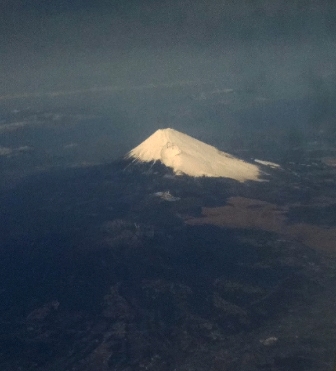
Fuji-san

After the morning’s excitement the flight to Okinawa can only be described as uneventful. We did enjoy a wonderful aerial view of Fuji early in our flight, and I shot a few lousy photos through the plane’s window. Tokyo had snow as recently as last week, and Fuji-san gleamed in all its glory.

After checking in to our hotel here in Naha, and enjoying an afternoon nap, we met a friend of Cassady’s family, Mr. Iwama, downtown for dinner. The main drag in Naha is an endless maze of bars, restaurants, schlock shops, and local vendors. If you are willing to sort through most of the schlock there are local vendors with an impressive variety of local foods and crafts. We had no time for shopping, but we return to Naha in a couple of days and will have a chance to leave a few yen here.

We met Mr. Iwama, and snaked through the shops and tourists to the restaurant – Tedakotei We were greeted first by a bright “No War, Stop War” plea plastered on the front door (good sign), and then by our hostess – Midori Iizuka. The restaurant holds no more than five tables, with a few tatami mats in one corner. Midora is both cook and waitress, and the cuisine is Okinawan-Italian. Midora has lived all over the world, and fell in love with cooking in Italy. She brought her passion and her skill back to Okinawa, and we enjoyed the results. By the way, we relished the array of cheeses for desert. These included one from Hokkaido, as well as a local goat cheese.

Dinner at Tedakotei

After dinner we left our host and wandered over to the obligatory Starbucks. This is cherry blossom season (or at least the beginning), and every shop has some reference to “sakura”. Our granddaughter’s Japanese name is Sakura, or cherry blosson, so this is a fortuitous time of year for her. We sat outside by the main drag and watched the local Okinawan young men race their motorcycles through what seemed to me to be an impassable jam of traffic, admired by the stylish young women who strutted by.

We leave this morning for the north of the island, and (finally) a day outside. At last I will have the opportunity to use my camera (rather than my IPhone). More posts and photos will follow.

Ted

Tokyo – The Rising Sun


Tempura cooks at the Imperial Hotel


The sun has yet to rise here in Tokyo. We arrived at Narita around 4 PM, took the bus to the Imperial Hotel, and I collapsed into bed around 10 PM. Virginia and Cassady invaded the Ginza after dinner, but I begged off in favor of a good night’s sleep.

The Imperial Hotel is as gracious as ever. At this moment they have a display of artifacts from Frank Lloyd Wright’s 1923 masterpiece. Wright’s hotel replaced the original, built in 1890, so this is the third of the Imperial Hotels here. There are columns on display that are carved from Oya, the tuff endemic to Tochigi prefecture (where we will be visiting family at the end of the trip).

Last night we ate at our favorite tempura restaurant in Japan, located here in the Imperial. Among the specialties served were tempura fried fish backbones which look like pieces of cord tied in a knot, and crispy shrimp heads (nothing goes to waste).

The cooks here are masters at this one form of Japanese cuisine, and the light, delicate tempura here bears little resemblance to what we are served in the U.S.

We fly to Okinawa later this morning, and begin our trip to areas of Japan we have never visited before. For the next week we will be immersed in an overdose of WW II (Okinawa, Nagasaki, Hiroshima). We then spend time in Osaka and take in the spring basho.


Ted

12 March 2010

News about Illinois refuge project from Openlands

The movement to create the Hackmatack National Wildlife Refuge is gaining ground both in local communities and at the U.S. Fish & Wildlife Service (USFWS). Openlands, the Trust for Public Land, and area residents have requested that the USFWS conduct a feasibility study for recognizing the bi-state area of northern McHenry County, in Illinois, and southern Walworth County, in Wisconsin, as a potential urban refuge.

Also, Openlands and Trust for Public Land commissioned a viability study from Fermata Inc. to determine the value of the proposed refuge to local communities and the expectations for increased recreational and economic gains and lend credence to a refuge designation in this region. Click on this link to download the report.

The Cuts Continue

Here is a note from the Bird Conservation Alliance about two conservation programs facing cuts.

Joint Ventures

Joint Ventures (JVs) exemplify a highly successful, cost-effective approach to conservation. By applying science and bringing diverse constituents together, JVs across the United States have created a model for solving wildlife management problems and restoring habitats critical to conserving declining species. Nationally, JVs have protected, restored, or enhanced more than 13 million acres of important habitat for migratory bird species. There are currently 21 JVs in the United States that provide coordination for conservation planning and implementation of projects that benefit all migratory bird populations and other species.

Joint Ventures also have a long history of success in implementing bird conservation initiatives mandated by Congress and by international treaties. Projects are developed at the local level and implemented through diverse public/private partnerships. These projects reflect local values and needs, while addressing regional and national conservation priorities. The projects benefit not only birds, but many wildlife species, and have a positive impact on the health of watersheds and local economies.

Joint Ventures were funded at $14,000,000 in FY2010. Every dollar invested in JVs leverages more than $44 in non-federal partner funds (1999-2004) for on-the-ground habitat conservation and restoration projects, biological planning, and outreach. The President’s FY 2011 budget requests only $13,000,000 for JVs, a one million dollar cut from last year’s level, however, we believe JVs should be funded at $18,000,000 to allow them to meet their increased responsibilities.  This increase in funding would help strengthen the public/private partnerships that leverage increasingly scarce public funds for on-the-ground habitat restoration and acquisition projects; continue to incorporate recent scientific advances in the development of landscape-conservation plans; and build capacity within the newer Joint Ventures, while maintaining expertise within established ones.

Neotropical Migratory Bird Conservation Act (NMBCA)

The Neotropical Migratory Bird Conservation Act (NMBCA) supports partnership programs to conserve birds in the United States, Canada, Latin America, and the Caribbean, where approximately five billion birds of over 500 species, including some of the most endangered birds in North America, spend their winters. Projects include activities that benefit bird populations such as habitat restoration, research and monitoring, law enforcement, and outreach and education.

Between 2002 and 2008, the program supported 260 projects, coordinated by partners in 44 U.S. states/territories and 34 countries. More than $25 million in federally appropriated dollars have leveraged over $116 million in partner contributions. Projects involving land conservation have affected about 3 million acres of bird habitat. However, demand for funding of high-quality conservation projects far outstrips current appropriations, and in 2008, 63 projects requesting nearly $10,000,000 were not funded. From these numbers, it is clear that conservation that would benefit our migrant songbirds is not able to take place due to a lack of funding for this program.

Of the 341 songbird and other neotropical migratory species that breed in the United States, 127 are known to be in decline, 60 of which have suffered population losses of more than 45% in the past 40 years.  Deforestation, especially in Latin America where many of these birds winter, is accelerating at an alarming rate, driven by the needs of a human population that has tripled in the last fifty years.  Estimates of the percentage of remaining forests that are lost each year in the Neotropics are between 1-2%.

Last year Congress funded the program at $5 million. The President’s budget only requests $4 million which translates into fewer grants approved and fewer conservation projects which would benefit hundreds of migratory birds which are known to be in decline.  We request that Congress fund NMBCA at $6.5 million.  This small investment will go a long way towards saving birds that generate millions of dollars for our economy and bring so much enjoyment to our lives.

Thanks to Steve Holmer for the information. You can contact Steve as follows:

Steve Holmer

Director of the Bird Conservation Alliance &

Senior Policy Advisor

American Bird Conservancy

202/234-7181 ext. 216

sholmer@abcbirds.org

www.birdconservationalliance.org

www.abcbirds.org